A Guide to Analyzing Balance Sheet Inventory for Investors
2025-12-21
When you look at a company’s financial statements, balance sheet inventory is simply the total value of all goods it has on hand, ready to sell. It’s classified as a current asset because it’s a direct investment in future sales, making it a vital sign of a company’s operational health and short-term financial stability.
What Is Inventory on a Balance Sheet?
Think of a company’s inventory as its lifeblood-it’s the physical product that ultimately brings in the cash. For a retailer, it’s the clothes hanging on the racks. For a car manufacturer, it’s the steel, the half-built cars on the assembly line, and the finished vehicles sitting in the lot. On the balance sheet, this number is far more than just a bookkeeping entry; it tells a compelling story about how the business is running.
As a current asset, inventory is expected to be sold and converted into cash within one year. This makes it a core component of working capital and a key clue into a company’s ability to pay its bills. A lean, well-managed inventory line signals efficiency. A bloated one can be a major red flag. If you want to see how this fits into the bigger financial picture, check out our complete guide to the balance sheet.
The Strategic Importance of Inventory
Managing inventory is much more than just counting boxes. It’s a delicate balancing act. Hold too much, and you tie up precious cash, rack up storage costs, and risk products becoming obsolete. Hold too little, and you face stockouts, which means lost sales and frustrated customers.
For an investor, the inventory figure is a direct reflection of management’s competence. It reveals how well the business can predict customer demand, manage its supply chain, and keep costs in check.
Recent economic swings have put this balancing act to the test. By 2022, inventory-to-sales ratios in the U.S. shot up to 1.48, a level not seen since 1992. This spike represented a massive 20-30% increase over pre-pandemic levels in major sectors like manufacturing and retail, showing just how fast things can go wrong. You can dig deeper into these balance sheet trends to see the full impact.
What Inventory Includes
To really understand what that single number on the balance sheet means, it helps to break it down. Depending on the type of business, inventory typically falls into one of three buckets:
- Raw Materials: The basic parts and components a manufacturer uses to build its products. Think lumber for a furniture maker or silicon for a chip company.
- Work-in-Progress (WIP): These are the partially assembled goods still making their way through the production line.
- Finished Goods: The final products, all boxed up and ready to be shipped to customers.
By tracking the value and flow of these categories, an investor can get a much clearer picture of a company’s operational rhythm and its prospects for future sales.
For investors trying to get a handle on a company’s inventory, it’s helpful to have a quick reference for the key metrics and concepts. The table below summarizes what to look for and what it tells you.
Key Inventory Metrics at a Glance
| Concept | What It Tells an Investor | Where to Find It |
|---|---|---|
| Inventory Value | The total cost of goods on hand. A sudden spike or drop can signal demand issues or supply chain problems. | Balance Sheet (Current Assets) |
| Inventory Turnover | How quickly a company sells its inventory. A high turnover is good; a low one suggests weak sales or overstocking. | Calculated: Cost of Goods Sold / Average Inventory |
| Days Sales of Inventory (DSI) | The average number of days it takes to sell off inventory. Lower is generally better. | Calculated: (Average Inventory / COGS) * 365 |
| Inventory-to-Sales Ratio | Compares inventory levels to sales. A rising ratio might indicate that inventory is piling up faster than it’s being sold. | Often found in management discussion and analysis (MD&A) or calculated from financial statements. |
| Write-Downs/Obsolescence | Charges for inventory that has lost value. Frequent write-downs are a major red flag for poor inventory management. | Notes to the Financial Statements |
This table serves as a great starting point. By keeping these metrics in mind as you review a company’s financials, you can quickly spot potential strengths and weaknesses in its operations.
How Companies Value Their Inventory
Imagine a local coffee shop. The owner buys bags of coffee beans throughout the month, but the price for those beans keeps changing. When a customer orders a latte, which bag of beans did the shop “use” to make it? The one they bought yesterday for $12, or the one they bought last week for $10?
This isn’t just a trivial question for the barista; it’s a critical accounting choice that can dramatically alter the coffee shop’s financial story. This is the heart of inventory valuation. Companies can’t just guess the value of goods left on their shelves. They have to use a consistent, recognized method to figure out their cost of goods sold (COGS) and the value of their remaining balance sheet inventory. The method they pick has a real impact on reported profits, how much tax they pay, and the asset value shown on their balance sheet.
First-In, First-Out (FIFO)
The First-In, First-Out (FIFO) method is the most intuitive and widely used. It works just like it sounds: the first items that come into the warehouse are assumed to be the first ones sold. Think of a grocery store stocking milk-they always push the oldest cartons to the front so they sell before expiring. Simple.
For our coffee shop, this means the first bags of beans bought (at the older, lower prices) are assumed to be the first ones ground up for customers. During a period of rising prices, or inflation, this is great for reported profits. FIFO matches the older, cheaper costs against current revenue, resulting in a lower COGS. The inventory still on the balance sheet gets valued at the more recent, higher prices, beefing up the company’s asset value and net income.
Last-In, First-Out (LIFO)
Now let’s flip that idea on its head. The Last-In, First-Out (LIFO) method assumes the most recently purchased items are sold first. Picture a hardware store with a big barrel of nails; they just scoop from the top, selling the newest ones first because they’re easiest to grab.
If our coffee shop uses LIFO while bean prices are climbing, it matches the newest, most expensive beans against its revenue. This creates a higher COGS, which shrinks the company’s reported net income. So why would anyone do this? The big advantage is a lower tax bill. The trade-off is that the inventory left on the balance sheet is valued at much older, lower costs, which can seriously understate its true current value.
Weighted-Average Cost
The Weighted-Average Cost method is the great equalizer. It smooths everything out by calculating the average cost of all the goods available for sale during a period. That single average cost is then applied to both the items sold (COGS) and the items still sitting in inventory.
This approach offers a middle ground between the extremes of FIFO and LIFO, preventing profit and inventory values from swinging wildly with every price fluctuation. It’s a practical choice for companies selling huge volumes of identical products-like gasoline stations or grain suppliers-where tracking the cost of each individual unit would be a nightmare.
Of course, the true cost of inventory goes beyond just the purchase price. Smart investors also dig into related expenses, such as inventory carrying costs, to get the full picture of a company’s profitability.
Impact of Valuation Methods During Inflation
Choosing between FIFO, LIFO, and Weighted-Average isn’t just an academic exercise, especially when costs are rising. The table below breaks down how each method directly affects a company’s financial statements during inflationary periods.
| Metric | FIFO (First-In, First-Out) | LIFO (Last-In, First-Out) | Weighted-Average |
|---|---|---|---|
| Cost of Goods Sold | Lower (based on older, cheaper costs) | Higher (based on recent, expensive costs) | Moderate (based on an average of all costs) |
| Reported Net Income | Higher (lower COGS leads to higher profit) | Lower (higher COGS leads to lower profit) | Moderate (smoothes out profit fluctuations) |
| Income Tax Expense | Higher (due to higher reported income) | Lower (due to lower reported income) | Moderate |
| Ending Inventory Value | Higher (valued at recent, higher prices) | Lower (valued at older, lower prices) | Moderate (reflects the average cost) |
As you can see, a company using FIFO during inflation will look more profitable and have a stronger balance sheet. In contrast, a LIFO company will report lower profits and pay less in taxes, but its inventory asset value might not reflect current market realities.
The stakes get even higher when supply chains are disrupted. The chart below shows just how dramatically inventory levels surged following the pandemic, making these valuation decisions more critical than ever.
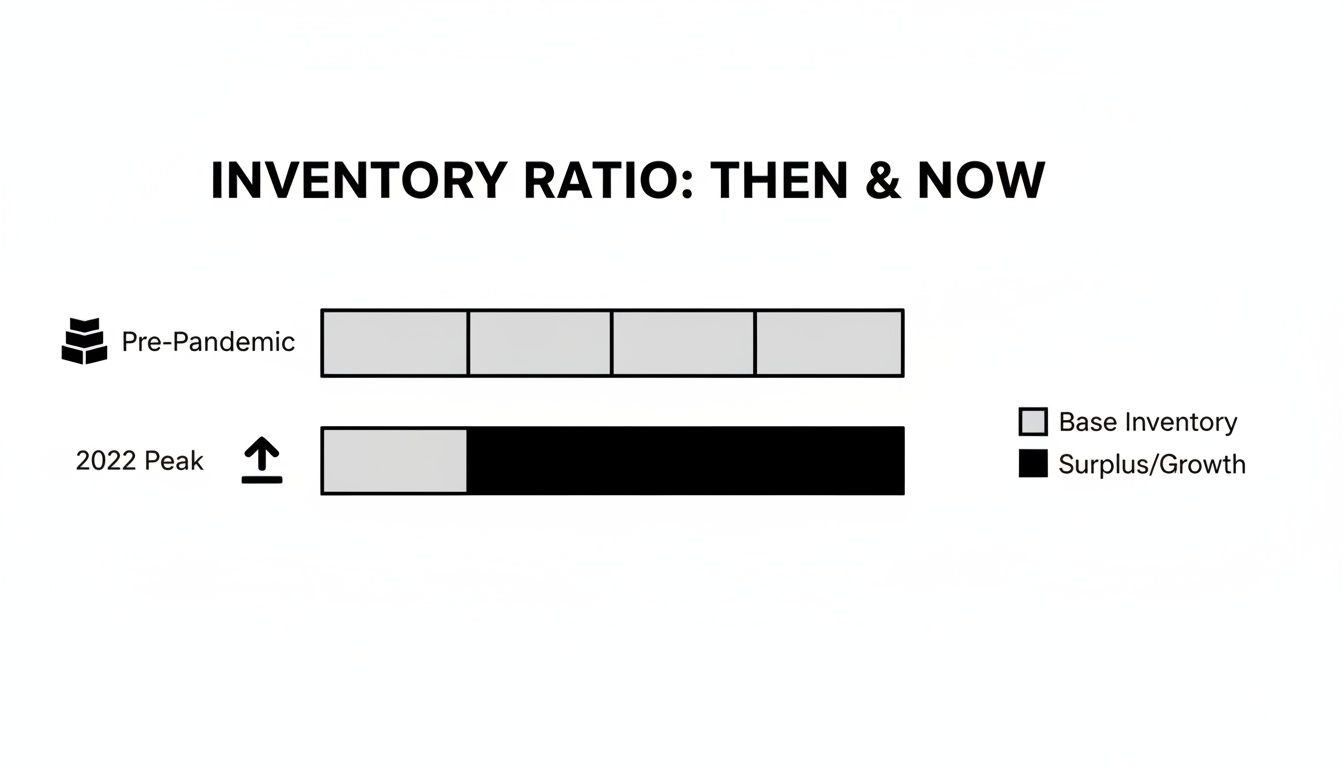
This massive inventory buildup from pre-pandemic norms to the 2022 peak shows why understanding a company’s valuation method is no small detail-it’s fundamental to properly analyzing its financial health in a volatile economy.
Where to Find and Interpret Inventory Data
The inventory figure staring at you from a company’s balance sheet is just the tip of the iceberg. It gives you a quick snapshot, sure, but the real story-the juicy details-is often tucked away in the financial reports. To truly get a handle on a company’s inventory health, you need to know where to look, starting with the balance sheet and then diving deep into the footnotes.
First things first, find the inventory line item on the balance sheet. You’ll always find it sitting under the “Current Assets” section. This number is the total book value of all the stuff the company has on hand, ready to sell. If you need a refresher on navigating this key financial statement, our guide on how to read a balance sheet will get you up to speed.
Digging into the Financial Footnotes
Now for the real detective work. The treasure trove of information isn’t that single number on the balance sheet; it’s in the notes to the financial statements. This is where companies are legally required to spill the beans on their accounting policies, giving you the context that the balance sheet figure alone just can’t provide.
Here’s what you should be hunting for in those footnotes:
- Valuation Method: Does the company use FIFO, LIFO, or a weighted-average cost? They have to tell you. This is non-negotiable for comparing firms, as the choice of method can seriously skew reported profits and asset values.
- Inventory Composition: Many companies will break down their inventory into categories like raw materials, work-in-progress, and finished goods. A sudden pile-up in one area, especially finished goods, can be a bright red flag for slowing sales.
- Write-Downs and Reserves: Keep an eye out for any mention of inventory write-downs or reserves for obsolescence. These are charges a company takes when its inventory loses value-a classic sign of poor demand forecasting or products that just aren’t moving.
Take a look at this example from Amazon’s 2022 annual report. It shows exactly how they lay out their inventory value on the balance sheet.
You can see “Inventories” clearly listed under “Current assets,” with a value of $34.96 billion at the end of 2022, which was actually a drop from the previous year.
Connecting the Dots for a Complete Picture
Don’t underestimate the importance of this metric; inventory is becoming a bigger and bigger piece of the financial puzzle. For S&P 500 companies, inventory has swelled from about 12% of total assets back in 2000 to nearly 18% today. That’s a significant shift, highlighting just how critical it is for investors to pay attention.
Inventory tells you a lot, but it doesn’t tell you everything. Beyond the balance sheet, a company’s profitability is laid bare in its Profit and Loss (P&L) statement. For a complete guide to understanding this crucial document, which goes hand-in-hand with the balance sheet, check out this excellent resource on reading a Profit and Loss (P&L) statement.
Using Key Ratios to Analyze Inventory Health
Looking at the raw numbers on a financial statement is a start, but the real analysis begins when you use them to measure performance. When it comes to balance sheet inventory, key ratios are your best friend. They cut through the noise, giving you a clear, standardized way to judge just how well a company is managing its stock.
These ratios are what turn static figures into dynamic insights. They can reveal trends in how fast products are selling, where operational bottlenecks are forming, and ultimately, how profitable the whole operation is. By calculating and comparing these metrics, you stop being a passive reader of a balance sheet and become an active interpreter of the story it tells.
Inventory Turnover Ratio
The inventory turnover ratio is the classic metric for gauging a company’s operational speed. It tells you how many times a company sells and replaces its entire stock of goods over a specific period, usually a year.
Generally, a higher number is a good sign-it points to strong sales and efficient, lean operations. On the flip side, a low number can be a red flag for weak sales or an bloated inventory that’s tying up precious cash.
- Formula: Cost of Goods Sold (COGS) / Average Inventory
- What It Measures: The velocity of sales and the demand for a company’s products.
- Interpretation: Context is everything here. A fast-fashion giant like Zara will have an incredibly high turnover, while a luxury jeweler like Tiffany & Co. will naturally have a much lower one.
Improving this single ratio can have a massive impact. For example, US corporations that managed to boost their inventory turnover from 4x to 6x in recent years saw their return on invested capital (ROIC) jump by 3 percentage points. It’s a perfect illustration of how optimizing balance sheet inventory flows directly to the bottom line.
Days Sales of Inventory (DSI)
While turnover tells you how many times inventory is sold, Days Sales of Inventory (DSI) tells you how long it sits around. This ratio calculates the average number of days an item hangs out on the shelves before someone buys it. A lower DSI is what you want to see, as it means the company is converting its inventory into cash more quickly.
A rising DSI can be an early warning sign. It suggests that inventory is becoming harder to sell, which could lead to future write-downs and hurt profitability.
Think of DSI as the “shelf life” of the inventory, measured in days. It gives you a much more tangible feel for the company’s sales cycle compared to the turnover ratio alone.
Gross Margin Return on Inventory (GMROI)
Finally, we get to the Gross Margin Return on Inventory (GMROI), which directly connects inventory management to profitability. This powerful ratio answers one of the most important questions you can ask: “For every dollar I invest in inventory, how much gross profit am I getting back?”
If the GMROI is greater than 1.0, it means the company is successfully selling its goods for more than it cost to get them.
- Formula: Gross Profit / Average Inventory Cost
- What It Measures: The profitability of the company’s investment in its inventory.
- Interpretation: This ratio helps you see if a company is just moving products, or if it’s moving them profitably.
Getting a handle on these three ratios is fundamental for any serious investor. To get more comfortable with these and other key metrics, check out our comprehensive financial ratios cheat sheet.
Spotting Red Flags in Inventory Reporting
Digging into a company’s balance sheet inventory is less about crunching numbers and more about becoming a financial detective. The figures can tell a story of booming success, but they can just as easily hide serious operational problems-or even outright accounting fraud. Learning to spot these warning signs is absolutely critical for any investor trying to sidestep costly traps.
These red flags are rarely giant, flashing lights. They’re subtle clues hinting at deeper issues, like slowing sales, sloppy management, or a desperate attempt to paint a rosier financial picture than reality. If you ignore them, you could be in for significant losses down the road.
Inventory Growing Faster Than Sales
This is one of the oldest tricks in the book and a classic warning sign. When a company’s inventory consistently piles up faster than its revenue grows, something’s off. A brief spike might be justifiable-maybe for a big product launch or seasonal demand-but a persistent trend is a major cause for concern.
This growing gap signals that the company is making or buying products faster than customers are buying them. It could mean demand is drying up, their forecasting is terrible, or their products are on the fast track to becoming obsolete. No matter the cause, all that unsold stock ties up precious cash, racks up storage costs, and dramatically increases the risk of a future write-down that will hammer the company’s earnings.
Declining Inventory Turnover
Another huge red flag is a steadily falling inventory turnover ratio. As we’ve covered, this metric shows how quickly a company is moving its stock. When that number keeps dropping, it’s a clear sign that products are collecting dust on the shelves for longer and longer.
This slowdown can point to a few different problems:
- Waning Product Popularity: The market might be losing interest in what the company is selling.
- Ineffective Sales Strategy: The marketing and sales teams simply aren’t getting the job done.
- Overproduction or Over-purchasing: Management got too optimistic and now they’re stuck with a mountain of unsold goods.
When you see turnover declining quarter after quarter, it’s a clear signal to investigate further. This isn’t just a number; it’s a direct reflection of a company’s ability to connect with its customers and manage its core operations.
Suspicious Accounting Changes
Tread very carefully when you see a company suddenly change its inventory accounting methods without a good explanation. For instance, if a company switches from LIFO to FIFO during a period of rising prices, it can instantly-and artificially-boost its reported profits and the value of its inventory. Companies have to disclose these changes, but you need to read the footnotes with a healthy dose of skepticism.
Similarly, keep an eye out for unusually large or frequent inventory write-downs. The opposite can also be a red flag. If a company is in a fast-paced industry like tech but never seems to write off obsolete stock while its competitors are, it could be improperly delaying losses to keep its assets and earnings looking inflated.
The Big Picture: What Inventory Really Tells You
When it’s all said and done, balance sheet inventory is so much more than just another line item in a financial report. Think of it as the company’s pulse-a living, breathing indicator of its operational health, its connection to customer demand, and its overall financial discipline. If you only look at the final number, you’re missing the real story of how the business actually works day-to-day.
Learning to read between the lines of inventory gives you a serious advantage. It means knowing how a simple choice between FIFO and LIFO can completely change a company’s reported profits. It means using a few key ratios to instantly gauge how efficiently a business is running. And, most importantly, it means you can spot the subtle red flags-like inventory piling up faster than sales are growing-that often signal trouble long before it makes the news.
Forget thinking of inventory analysis as a chore. See it for what it is: a powerful lens that sharpens your focus, helping you separate the well-oiled machines from the companies sputtering with inefficiencies or even hiding deeper problems.
Once you start applying these strategies, the balance sheet stops being a static historical document and becomes a tool for predicting the future. This shift from reactive to proactive analysis will empower you to make smarter, more confident investment decisions. In any market, your ability to understand the story behind the stock on the shelves is a massive asset.
Your Questions About Inventory Answered
Diving into a company’s inventory can bring up some tricky questions. Let’s tackle a few of the most common ones investors ask to help you get a better handle on your analysis.
Why Use LIFO if It Makes Profits Look Lower?
It might seem counterintuitive, but there’s one huge reason companies opt for LIFO, especially when costs are on the rise: tax savings. LIFO matches the newest, most expensive inventory costs against revenue, which inflates the Cost of Goods Sold (COGS).
A higher COGS means lower pre-tax income on the books. While this makes the bottom line on the income statement look a bit weaker, the real prize is a smaller tax bill. That cash saved is real money that can be plowed right back into the business, boosting actual cash flow.
What’s the Big Deal About an Inventory Write-Down?
An inventory write-down is a major red flag for any investor. This happens when a company admits that its inventory has lost value-maybe it’s damaged, obsolete, or simply not selling. The company has to reduce the inventory’s value on the balance sheet, and that loss hits the income statement directly, eroding profits.
For an investor, frequent or large write-downs are a clear warning sign. They can point to serious issues like poor management, bad demand forecasting, or products that are losing their appeal. Ultimately, they signal a risk to the company’s future profits and operational health.
Can a Company Actually Have Too Little Inventory?
Absolutely. While everyone worries about having too much inventory tying up cash, the opposite problem can be just as destructive. Not having enough stock on hand leads to stockouts, which is just a fancy way of saying you can’t give customers what they want to buy.
The most immediate impact is lost sales. But the long-term damage can be much worse. Frustrated customers might just take their business to a competitor-and they may never come back. A super-high inventory turnover ratio might look great on paper, but it could be hiding the fact that the company is constantly understocked and leaving a ton of money on the table.
Unlock the stories hidden in financial statements. With Finzer, you can screen, compare, and track companies using powerful tools that turn complex data into clear, actionable insights. Start making more informed investment decisions today with Finzer.
Find good stocks, faster.
Screen, compare, and track companies in one place. Our AI explains the numbers in plain English so you can invest with confidence.
<p>When you look at a company’s financial statements, <strong>balance sheet inventory</strong> is simply the total value of all goods it has on hand, ready to sell. It’s classified as a <em>current asset</em> because it’s a direct investment in future sales, making it a vital sign of a company’s operational health and short-term financial stability.</p> <h2>What Is Inventory on a Balance Sheet?</h2> <p>Think of a company’s inventory as its lifeblood-it’s the physical product that ultimately brings in the cash. For a retailer, it’s the clothes hanging on the racks. For a car manufacturer, it’s the steel, the half-built cars on the assembly line, and the finished vehicles sitting in the lot. On the balance sheet, this number is far more than just a bookkeeping entry; it tells a compelling story about how the business is running.</p> <p>As a current asset, inventory is expected to be sold and converted into cash within one year. This makes it a core component of working capital and a key clue into a company’s ability to pay its bills. A lean, well-managed inventory line signals efficiency. A bloated one can be a major red flag. If you want to see how this fits into the bigger financial picture, check out our complete guide to the <a href="https://finzer.io/en/glossary/balance-sheet">balance sheet</a>.</p> <h3>The Strategic Importance of Inventory</h3> <p>Managing inventory is much more than just counting boxes. It’s a delicate balancing act. Hold too much, and you tie up precious cash, rack up storage costs, and risk products becoming obsolete. Hold too little, and you face stockouts, which means lost sales and frustrated customers.</p> <blockquote><p>For an investor, the inventory figure is a direct reflection of management’s competence. It reveals how well the business can predict customer demand, manage its supply chain, and keep costs in check.</p></blockquote> <p>Recent economic swings have put this balancing act to the test. By <strong>2022</strong>, inventory-to-sales ratios in the U.S. shot up to <strong>1.48</strong>, a level not seen since <strong>1992</strong>. This spike represented a massive <strong>20-30% increase</strong> over pre-pandemic levels in major sectors like manufacturing and retail, showing just how fast things can go wrong. You can dig deeper into these <a href="https://www.bcg.com/publications/2025/three-factors-driving-firms-to-improve-balance-sheets">balance sheet trends</a> to see the full impact.</p> <h3>What Inventory Includes</h3> <p>To really understand what that single number on the balance sheet means, it helps to break it down. Depending on the type of business, inventory typically falls into one of three buckets:</p> <ul> <li><strong>Raw Materials:</strong> The basic parts and components a manufacturer uses to build its products. Think lumber for a furniture maker or silicon for a chip company.</li> <li><strong>Work-in-Progress (WIP):</strong> These are the partially assembled goods still making their way through the production line.</li> <li><strong>Finished Goods:</strong> The final products, all boxed up and ready to be shipped to customers.</li> </ul> <p>By tracking the value and flow of these categories, an investor can get a much clearer picture of a company’s operational rhythm and its prospects for future sales.</p> <p>For investors trying to get a handle on a company’s inventory, it’s helpful to have a quick reference for the key metrics and concepts. The table below summarizes what to look for and what it tells you.</p> <h3>Key Inventory Metrics at a Glance</h3> <table> <thead> <tr> <th align="left">Concept</th> <th align="left">What It Tells an Investor</th> <th align="left">Where to Find It</th> </tr> </thead> <tbody> <tr> <td align="left"><strong>Inventory Value</strong></td> <td align="left">The total cost of goods on hand. A sudden spike or drop can signal demand issues or supply chain problems.</td> <td align="left">Balance Sheet (Current Assets)</td> </tr> <tr> <td align="left"><strong>Inventory Turnover</strong></td> <td align="left">How quickly a company sells its inventory. A high turnover is good; a low one suggests weak sales or overstocking.</td> <td align="left">Calculated: Cost of Goods Sold / Average Inventory</td> </tr> <tr> <td align="left"><strong>Days Sales of Inventory (DSI)</strong></td> <td align="left">The average number of days it takes to sell off inventory. Lower is generally better.</td> <td align="left">Calculated: (Average Inventory / COGS) * 365</td> </tr> <tr> <td align="left"><strong>Inventory-to-Sales Ratio</strong></td> <td align="left">Compares inventory levels to sales. A rising ratio might indicate that inventory is piling up faster than it’s being sold.</td> <td align="left">Often found in management discussion and analysis (MD&A) or calculated from financial statements.</td> </tr> <tr> <td align="left"><strong>Write-Downs/Obsolescence</strong></td> <td align="left">Charges for inventory that has lost value. Frequent write-downs are a major red flag for poor inventory management.</td> <td align="left">Notes to the Financial Statements</td> </tr> </tbody> </table> <p>This table serves as a great starting point. By keeping these metrics in mind as you review a company’s financials, you can quickly spot potential strengths and weaknesses in its operations.</p> <h2>How Companies Value Their Inventory</h2> <p>Imagine a local coffee shop. The owner buys bags of coffee beans throughout the month, but the price for those beans keeps changing. When a customer orders a latte, which bag of beans did the shop “use” to make it? The one they bought yesterday for $12, or the one they bought last week for $10?</p> <p>This isn’t just a trivial question for the barista; it’s a critical accounting choice that can dramatically alter the coffee shop’s financial story. This is the heart of inventory valuation. Companies can’t just guess the value of goods left on their shelves. They have to use a consistent, recognized method to figure out their cost of goods sold (COGS) and the value of their remaining <strong>balance sheet inventory</strong>. The method they pick has a real impact on reported profits, how much tax they pay, and the asset value shown on their balance sheet.</p> <h3>First-In, First-Out (FIFO)</h3> <p>The <strong>First-In, First-Out (FIFO)</strong> method is the most intuitive and widely used. It works just like it sounds: the first items that come into the warehouse are assumed to be the first ones sold. Think of a grocery store stocking milk-they always push the oldest cartons to the front so they sell before expiring. Simple.</p> <p>For our coffee shop, this means the first bags of beans bought (at the older, lower prices) are assumed to be the first ones ground up for customers. During a period of rising prices, or inflation, this is great for reported profits. FIFO matches the older, cheaper costs against current revenue, resulting in a lower COGS. The inventory still on the balance sheet gets valued at the more recent, higher prices, beefing up the company’s asset value and net income.</p> <h3>Last-In, First-Out (LIFO)</h3> <p>Now let’s flip that idea on its head. The <strong>Last-In, First-Out (LIFO)</strong> method assumes the <em>most recently</em> purchased items are sold first. Picture a hardware store with a big barrel of nails; they just scoop from the top, selling the newest ones first because they’re easiest to grab.</p> <p>If our coffee shop uses LIFO while bean prices are climbing, it matches the newest, most expensive beans against its revenue. This creates a higher COGS, which shrinks the company’s reported net income. So why would anyone do this? The big advantage is a lower tax bill. The trade-off is that the inventory left on the balance sheet is valued at much older, lower costs, which can seriously understate its true current value.</p> <h3>Weighted-Average Cost</h3> <p>The <strong>Weighted-Average Cost</strong> method is the great equalizer. It smooths everything out by calculating the average cost of all the goods available for sale during a period. That single average cost is then applied to both the items sold (COGS) and the items still sitting in inventory.</p> <p>This approach offers a middle ground between the extremes of FIFO and LIFO, preventing profit and inventory values from swinging wildly with every price fluctuation. It’s a practical choice for companies selling huge volumes of identical products-like gasoline stations or grain suppliers-where tracking the cost of each individual unit would be a nightmare.</p> <p>Of course, the true cost of inventory goes beyond just the purchase price. Smart investors also dig into related expenses, such as <a href="https://tociny.ai/blog/what-is-inventory-carrying-cost">inventory carrying costs</a>, to get the full picture of a company’s profitability.</p> <h4>Impact of Valuation Methods During Inflation</h4> <p>Choosing between FIFO, LIFO, and Weighted-Average isn’t just an academic exercise, especially when costs are rising. The table below breaks down how each method directly affects a company’s financial statements during inflationary periods.</p> <table> <thead> <tr> <th align="left">Metric</th> <th align="left">FIFO (First-In, First-Out)</th> <th align="left">LIFO (Last-In, First-Out)</th> <th align="left">Weighted-Average</th> </tr> </thead> <tbody> <tr> <td align="left"><strong>Cost of Goods Sold</strong></td> <td align="left">Lower (based on older, cheaper costs)</td> <td align="left">Higher (based on recent, expensive costs)</td> <td align="left">Moderate (based on an average of all costs)</td> </tr> <tr> <td align="left"><strong>Reported Net Income</strong></td> <td align="left">Higher (lower COGS leads to higher profit)</td> <td align="left">Lower (higher COGS leads to lower profit)</td> <td align="left">Moderate (smoothes out profit fluctuations)</td> </tr> <tr> <td align="left"><strong>Income Tax Expense</strong></td> <td align="left">Higher (due to higher reported income)</td> <td align="left">Lower (due to lower reported income)</td> <td align="left">Moderate</td> </tr> <tr> <td align="left"><strong>Ending Inventory Value</strong></td> <td align="left">Higher (valued at recent, higher prices)</td> <td align="left">Lower (valued at older, lower prices)</td> <td align="left">Moderate (reflects the average cost)</td> </tr> </tbody> </table> <p>As you can see, a company using FIFO during inflation will look more profitable and have a stronger balance sheet. In contrast, a LIFO company will report lower profits and pay less in taxes, but its inventory asset value might not reflect current market realities.</p> <p>The stakes get even higher when supply chains are disrupted. The chart below shows just how dramatically inventory levels surged following the pandemic, making these valuation decisions more critical than ever.</p> <figure class="wp-block-image size-large"><img data-recalc-dims="1" decoding="async" src="https://i0.wp.com/cdn.outrank.so/6540ba8a-af29-418a-9ef5-c1e2a673f1e1/6b0aa982-51cd-4a47-874e-3ae8fef7de9f/balance-sheet-inventory-inventory-growth.jpg?ssl=1" alt="Bar chart comparing inventory ratios: pre-pandemic base inventory versus 2022 peak surplus growth." /></figure> <p>This massive inventory buildup from pre-pandemic norms to the <strong>2022</strong> peak shows why understanding a company’s valuation method is no small detail-it’s fundamental to properly analyzing its financial health in a volatile economy.</p> <h2>Where to Find and Interpret Inventory Data</h2> <p>The inventory figure staring at you from a company’s balance sheet is just the tip of the iceberg. It gives you a quick snapshot, sure, but the real story-the juicy details-is often tucked away in the financial reports. To truly get a handle on a company’s inventory health, you need to know where to look, starting with the balance sheet and then diving deep into the footnotes.</p> <p>First things first, find the <strong>inventory</strong> line item on the balance sheet. You’ll always find it sitting under the “Current Assets” section. This number is the total book value of all the stuff the company has on hand, ready to sell. If you need a refresher on navigating this key financial statement, our guide on <a href="https://finzer.io/en/blog/how-to-read-a-balance-sheet">how to read a balance sheet</a> will get you up to speed.</p> <h3>Digging into the Financial Footnotes</h3> <p>Now for the real detective work. The treasure trove of information isn’t that single number on the balance sheet; it’s in the notes to the financial statements. This is where companies are legally required to spill the beans on their accounting policies, giving you the context that the balance sheet figure alone just can’t provide.</p> <p>Here’s what you should be hunting for in those footnotes:</p> <ul> <li><strong>Valuation Method:</strong> Does the company use FIFO, LIFO, or a weighted-average cost? They have to tell you. This is non-negotiable for comparing firms, as the choice of method can seriously skew reported profits and asset values.</li> <li><strong>Inventory Composition:</strong> Many companies will break down their inventory into categories like raw materials, work-in-progress, and finished goods. A sudden pile-up in one area, especially finished goods, can be a bright red flag for slowing sales.</li> <li><strong>Write-Downs and Reserves:</strong> Keep an eye out for any mention of inventory write-downs or reserves for obsolescence. These are charges a company takes when its inventory loses value-a classic sign of poor demand forecasting or products that just aren’t moving.</li> </ul> <p>Take a look at this example from Amazon’s 2022 annual report. It shows exactly how they lay out their inventory value on the balance sheet.</p> <p>You can see “Inventories” clearly listed under “Current assets,” with a value of <strong>$34.96 billion</strong> at the end of 2022, which was actually a drop from the previous year.</p> <h3>Connecting the Dots for a Complete Picture</h3> <p>Don’t underestimate the importance of this metric; inventory is becoming a bigger and bigger piece of the financial puzzle. For S&P 500 companies, inventory has swelled from about <strong>12%</strong> of total assets back in 2000 to nearly <strong>18%</strong> today. That’s a significant shift, highlighting just how critical it is for investors to pay attention.</p> <blockquote><p>Inventory tells you a lot, but it doesn’t tell you everything. Beyond the balance sheet, a company’s profitability is laid bare in its Profit and Loss (P&L) statement. For a complete guide to understanding this crucial document, which goes hand-in-hand with the balance sheet, check out this excellent resource on <a href="https://www.metricmosaic.io/blog/what-is-p-and-l">reading a Profit and Loss (P&L) statement</a>.</p></blockquote> <h2>Using Key Ratios to Analyze Inventory Health</h2> <p>Looking at the raw numbers on a financial statement is a start, but the real analysis begins when you use them to measure performance. When it comes to <strong>balance sheet inventory</strong>, key ratios are your best friend. They cut through the noise, giving you a clear, standardized way to judge just how well a company is managing its stock.</p> <p>These ratios are what turn static figures into dynamic insights. They can reveal trends in how fast products are selling, where operational bottlenecks are forming, and ultimately, how profitable the whole operation is. By calculating and comparing these metrics, you stop being a passive reader of a balance sheet and become an active interpreter of the story it tells.</p> <h3>Inventory Turnover Ratio</h3> <p>The <strong>inventory turnover ratio</strong> is the classic metric for gauging a company’s operational speed. It tells you how many times a company sells and replaces its entire stock of goods over a specific period, usually a year.</p> <p>Generally, a higher number is a good sign-it points to strong sales and efficient, lean operations. On the flip side, a low number can be a red flag for weak sales or an bloated inventory that’s tying up precious cash.</p> <ul> <li><strong>Formula:</strong> Cost of Goods Sold (COGS) / Average Inventory</li> <li><strong>What It Measures:</strong> The velocity of sales and the demand for a company’s products.</li> <li><strong>Interpretation:</strong> Context is everything here. A fast-fashion giant like Zara will have an incredibly high turnover, while a luxury jeweler like Tiffany & Co. will naturally have a much lower one.</li> </ul> <p>Improving this single ratio can have a massive impact. For example, US corporations that managed to boost their inventory turnover from <strong>4x</strong> to <strong>6x</strong> in recent years saw their return on invested capital (ROIC) jump by <strong>3</strong> percentage points. It’s a perfect illustration of how optimizing <strong>balance sheet inventory</strong> flows directly to the bottom line.</p> <h3>Days Sales of Inventory (DSI)</h3> <p>While turnover tells you <em>how many times</em> inventory is sold, <strong>Days Sales of Inventory (DSI)</strong> tells you <em>how long</em> it sits around. This ratio calculates the average number of days an item hangs out on the shelves before someone buys it. A lower DSI is what you want to see, as it means the company is converting its inventory into cash more quickly.</p> <blockquote><p>A rising DSI can be an early warning sign. It suggests that inventory is becoming harder to sell, which could lead to future write-downs and hurt profitability.</p></blockquote> <p>Think of DSI as the “shelf life” of the inventory, measured in days. It gives you a much more tangible feel for the company’s sales cycle compared to the turnover ratio alone.</p> <h3>Gross Margin Return on Inventory (GMROI)</h3> <p>Finally, we get to the <strong>Gross Margin Return on Inventory (GMROI)</strong>, which directly connects inventory management to profitability. This powerful ratio answers one of the most important questions you can ask: “For every dollar I invest in inventory, how much gross profit am I getting back?”</p> <p>If the GMROI is greater than <strong>1.0</strong>, it means the company is successfully selling its goods for more than it cost to get them.</p> <ul> <li><strong>Formula:</strong> Gross Profit / Average Inventory Cost</li> <li><strong>What It Measures:</strong> The profitability of the company’s investment in its inventory.</li> <li><strong>Interpretation:</strong> This ratio helps you see if a company is just moving products, or if it’s moving them <em>profitably</em>.</li> </ul> <p>Getting a handle on these three ratios is fundamental for any serious investor. To get more comfortable with these and other key metrics, check out our comprehensive <a href="https://finzer.io/en/blog/financial-ratios-cheat-sheet">financial ratios cheat sheet</a>.</p> <h2>Spotting Red Flags in Inventory Reporting</h2> <p>Digging into a company’s <strong>balance sheet inventory</strong> is less about crunching numbers and more about becoming a financial detective. The figures can tell a story of booming success, but they can just as easily hide serious operational problems-or even outright accounting fraud. Learning to spot these warning signs is absolutely critical for any investor trying to sidestep costly traps.</p> <p>These red flags are rarely giant, flashing lights. They’re subtle clues hinting at deeper issues, like slowing sales, sloppy management, or a desperate attempt to paint a rosier financial picture than reality. If you ignore them, you could be in for significant losses down the road.</p> <h3>Inventory Growing Faster Than Sales</h3> <p>This is one of the oldest tricks in the book and a classic warning sign. When a company’s inventory consistently piles up faster than its revenue grows, something’s off. A brief spike might be justifiable-maybe for a big product launch or seasonal demand-but a persistent trend is a major cause for concern.</p> <p>This growing gap signals that the company is making or buying products faster than customers are buying them. It could mean demand is drying up, their forecasting is terrible, or their products are on the fast track to becoming obsolete. No matter the cause, all that unsold stock ties up precious cash, racks up storage costs, and dramatically increases the risk of a future write-down that will hammer the company’s earnings.</p> <h3>Declining Inventory Turnover</h3> <p>Another huge red flag is a steadily falling inventory turnover ratio. As we’ve covered, this metric shows how quickly a company is moving its stock. When that number keeps dropping, it’s a clear sign that products are collecting dust on the shelves for longer and longer.</p> <p>This slowdown can point to a few different problems:</p> <ul> <li><strong>Waning Product Popularity:</strong> The market might be losing interest in what the company is selling.</li> <li><strong>Ineffective Sales Strategy:</strong> The marketing and sales teams simply aren’t getting the job done.</li> <li><strong>Overproduction or Over-purchasing:</strong> Management got too optimistic and now they’re stuck with a mountain of unsold goods.</li> </ul> <blockquote><p>When you see turnover declining quarter after quarter, it’s a clear signal to investigate further. This isn’t just a number; it’s a direct reflection of a company’s ability to connect with its customers and manage its core operations.</p></blockquote> <h3>Suspicious Accounting Changes</h3> <p>Tread very carefully when you see a company suddenly change its inventory accounting methods without a good explanation. For instance, if a company switches from LIFO to FIFO during a period of rising prices, it can instantly-and artificially-boost its reported profits and the value of its inventory. Companies have to disclose these changes, but you need to read the footnotes with a healthy dose of skepticism.</p> <p>Similarly, keep an eye out for unusually large or frequent inventory write-downs. The opposite can also be a red flag. If a company is in a fast-paced industry like tech but <em>never</em> seems to write off obsolete stock while its competitors are, it could be improperly delaying losses to keep its assets and earnings looking inflated.</p> <h2>The Big Picture: What Inventory Really Tells You</h2> <p>When it’s all said and done, <strong>balance sheet inventory</strong> is so much more than just another line item in a financial report. Think of it as the company’s pulse-a living, breathing indicator of its operational health, its connection to customer demand, and its overall financial discipline. If you only look at the final number, you’re missing the real story of how the business actually works day-to-day.</p> <p>Learning to read between the lines of inventory gives you a serious advantage. It means knowing how a simple choice between FIFO and LIFO can completely change a company’s reported profits. It means using a few key ratios to instantly gauge how efficiently a business is running. And, most importantly, it means you can spot the subtle red flags-like inventory piling up faster than sales are growing-that often signal trouble long before it makes the news.</p> <blockquote><p>Forget thinking of inventory analysis as a chore. See it for what it is: a powerful lens that sharpens your focus, helping you separate the well-oiled machines from the companies sputtering with inefficiencies or even hiding deeper problems.</p></blockquote> <p>Once you start applying these strategies, the balance sheet stops being a static historical document and becomes a tool for predicting the future. This shift from reactive to proactive analysis will empower you to make smarter, more confident investment decisions. In any market, your ability to understand the story behind the stock on the shelves is a massive asset.</p> <h2>Your Questions About Inventory Answered</h2> <p>Diving into a company’s inventory can bring up some tricky questions. Let’s tackle a few of the most common ones investors ask to help you get a better handle on your analysis.</p> <h3>Why Use LIFO if It Makes Profits Look Lower?</h3> <p>It might seem counterintuitive, but there’s one huge reason companies opt for LIFO, especially when costs are on the rise: <strong>tax savings</strong>. LIFO matches the newest, most expensive inventory costs against revenue, which inflates the Cost of Goods Sold (COGS).</p> <p>A higher COGS means lower pre-tax income on the books. While this makes the bottom line on the income statement look a bit weaker, the real prize is a smaller tax bill. That cash saved is real money that can be plowed right back into the business, boosting actual cash flow.</p> <h3>What’s the Big Deal About an Inventory Write-Down?</h3> <p>An inventory write-down is a major red flag for any investor. This happens when a company admits that its inventory has lost value-maybe it’s damaged, obsolete, or simply not selling. The company has to reduce the inventory’s value on the balance sheet, and that loss hits the income statement directly, eroding profits.</p> <blockquote><p>For an investor, frequent or large write-downs are a clear warning sign. They can point to serious issues like poor management, bad demand forecasting, or products that are losing their appeal. Ultimately, they signal a risk to the company’s future profits and operational health.</p></blockquote> <h3>Can a Company Actually Have Too Little Inventory?</h3> <p>Absolutely. While everyone worries about having too much inventory tying up cash, the opposite problem can be just as destructive. Not having enough stock on hand leads to stockouts, which is just a fancy way of saying you can’t give customers what they want to buy.</p> <p>The most immediate impact is lost sales. But the long-term damage can be much worse. Frustrated customers might just take their business to a competitor-and they may never come back. A super-high inventory turnover ratio might look great on paper, but it could be hiding the fact that the company is constantly understocked and leaving a ton of money on the table.</p> <hr /> <p>Unlock the stories hidden in financial statements. With <strong>Finzer</strong>, you can screen, compare, and track companies using powerful tools that turn complex data into clear, actionable insights. <a href="https://finzer.io">Start making more informed investment decisions today with Finzer</a>.</p>
Maximize Your Investment Insights with Finzer
Explore powerful screening tools and discover smarter ways to analyze stocks.