Calculating Outstanding Shares A Guide for Accurate Valuations

2025-12-22

Before you can figure out what a company is truly worth, you have to get a handle on its outstanding shares. It’s a simple concept on the surface: this is the total number of shares a company has issued that are currently held by all its shareholders. This includes big institutional investors and restricted shares held by company insiders.

This number is the bedrock for calculating critical metrics like market capitalization and Earnings Per Share (EPS).

Why Outstanding Shares Are a Critical Valuation Metric

Honestly, if you’re serious about investing, you can’t ignore the share count. Without it, you’re flying blind. It’s like knowing a slice of pizza costs $5 but having no idea how many slices are in the whole pie. You can’t tell if you’re getting a good deal.

Let’s look at a quick example. Imagine two tech startups, Innovate Corp and Future Tech, both trading at $50 per share. At a glance, they might seem equally valuable.

But if Innovate Corp has 20 million shares outstanding, its market cap is a cool $1 billion. Future Tech, on the other hand, might have 200 million shares out there, pushing its market cap to a much heftier $10 billion.

That simple difference highlights a crucial lesson: the share price alone is almost meaningless without context. The number of outstanding shares tells you the real scale of the business.

The Foundation of Fair Comparison

Figuring out the outstanding shares is the first real step in valuing a company, since it feeds directly into the market capitalization formula. Without it, you can’t compare apples to apples. And the scale of this is massive-the global equity market cap recently hit an eye-watering $126.7 trillion, an 8.7% jump year-over-year. You can dig into the full details in SIFMA’s Capital Markets Fact Book.

This isn’t just a number on a spreadsheet; it represents real ownership. Each share is a tiny slice of the company. The more shares there are, the more slices the ownership pie is cut into, which can dilute the value and earnings tied to your individual shares.

In my experience, overlooking the share count is one of the most common-and costly-mistakes I see new investors make. It’s so easy to get mesmerized by a rising stock price, but if the company is busy issuing millions of new shares behind the scenes, your personal stake in the business is actually shrinking.

Setting the Stage for Deeper Analysis

Ultimately, mastering the outstanding shares calculation is your gateway to more sophisticated financial analysis. It’s the denominator in the all-important Earnings Per Share (EPS) formula, which is a key indicator of a company’s profitability.

  • Market Capitalization = Share Price x Outstanding Shares
  • Earnings Per Share (EPS) = Net Income / Outstanding Shares

As you can see, getting the share count wrong throws off all your subsequent valuation work. Throughout this guide, we’ll break down exactly how to find this number and calculate it with precision, so you can be confident your investment decisions are built on a rock-solid foundation.

Where to Find Share Data in SEC Filings

Before you start crunching any numbers, your first stop should always be the company’s official filings with the Securities and Exchange Commission (SEC). Forget third-party financial sites for a moment. SEC documents are the ground truth, raw and unfiltered.

For our purposes, the two most important reports are the annual 10-K and the quarterly 10-Q. I know these filings can look intimidatingly dense, but you don’t need to read them cover to cover. You just need to know where to look.

The Cover Page Shortcut

Want the quickest answer? Go straight to the cover page of the latest 10-K or 10-Q. Companies are required to disclose the number of shares outstanding as of the most recent practicable date, and they usually list it right near the top.

This gives you a fantastic, up-to-date snapshot. But it’s just that-a snapshot. To really understand the full picture and build an accurate calculation, you’ll want to dig just a little bit deeper into the financial statements themselves.

Diving Into the Balance Sheet

The Consolidated Balance Sheet is where you’ll find the puzzle pieces to verify the share count. Your target is the “Stockholders’ Equity” section. Here, you’ll find a few key line items:

  • Common Stock: This usually tells you the par value along with the number of shares authorized and, most importantly, issued.
  • Treasury Stock: This is the big one. It represents shares the company has bought back from the open market. These shares are technically issued, but they are not outstanding.

This is a critical distinction. Issued shares are all the shares a company has ever sold to the public. Outstanding shares, the number we actually care about, are the issued shares minus any treasury stock the company holds.

My personal tip is to always cross-reference the cover page number with what you can piece together from the balance sheet. If there’s a small discrepancy, it’s usually because the cover page figure is more recent. Understanding why they differ is what separates a quick check from a thorough analysis.

Getting comfortable with these documents is a fundamental skill. If you want to build a solid foundation, our guide on how to read earnings reports is a great place to start. And remember, beyond just SEC filings, companies often publish various financial reports for investors that can also contain this data. Once you know exactly where to look, you can gather the inputs for your calculations with complete confidence.

Calculating Basic Outstanding Shares With a Real Example

Alright, let’s get our hands dirty and move from theory to practice. Calculating basic outstanding shares is pretty simple once you know where to look for the numbers and what formula to use. Running through it once will give you the confidence to do this crucial step on your own.

The core formula you need is this:

Issued Shares – Treasury Shares = Basic Outstanding Shares

This little equation is your starting point. The real work isn’t the math; it’s digging up the two inputs-issued shares and treasury shares-directly from a company’s financial reports.

Finding the Data and Running the Numbers

Your go-to source is always going to be the company’s latest 10-K (annual) or 10-Q (quarterly) report. You can find these for free on the SEC’s EDGAR database. The gold is usually buried in the “Stockholders’ Equity” section of the Consolidated Balance Sheet.

Let’s walk through an example with a made-up company, “Global Tech Inc.”

Imagine you pull up Global Tech’s newest 10-Q. You scroll down to the balance sheet and find the following lines under Stockholders’ Equity:

  • Common Stock: 1,200,000,000 shares issued
  • Treasury Stock: 150,000,000 shares, at cost

With these two numbers in hand, the calculation is a piece of cake:

1,200,000,000 (Issued Shares) – 150,000,000 (Treasury Shares) = 1,050,000,000 Basic Outstanding Shares

That final number, 1.05 billion, is exactly what you’d use to calculate Global Tech’s market capitalization or its basic Earnings Per Share (EPS).

Here’s a look at the SEC’s EDGAR search page, your main portal for finding these critical documents.

Just type a company’s name or ticker symbol into that search bar, and you’ll get access to all its public filings, including the 10-K and 10-Q reports you need.

Common Pitfalls to Avoid

The math might be easy, but I’ve seen plenty of investors stumble over small mistakes that lead to big valuation errors. Watch out for these common slip-ups:

  • Ignoring Treasury Stock: A classic mistake is just grabbing the “issued shares” number. If you don’t subtract treasury shares, you’ll inflate the share count and make metrics like EPS look artificially worse than they are.
  • Using Outdated Filings: Share counts are always in flux. Always, always use the most recent 10-K or 10-Q to make sure your data is fresh.
  • Confusing Authorized Shares with Issued Shares: Don’t get tripped up by the “authorized” number. That’s just the maximum number of shares a company can issue, not how many it has issued. It’s irrelevant for this calculation.

The key takeaway here is that precision is everything. The number of outstanding shares isn’t set in stone; it shifts with corporate actions like stock buybacks or new issuances. Always double-check your source and the date of the filing.

These changes can have a massive impact. A perfect real-world example unfolded during the 2008 financial crisis when U.S. banks like JPMorgan Chase saw their share counts change dramatically. Before the crisis in 2007, JPMorgan had about 3.3 billion shares outstanding. By 2009, after bailouts and acquisitions, that number had swelled to around 3.8 billion. This dilution completely altered its market dynamics. You can find more insights into share count history and its effects on various companies over time.

Understanding Diluted Shares for a Fuller Picture

Once you’ve got a handle on the basic outstanding share count, it’s time to dig a little deeper. The basic number gives you a snapshot of the company today, but it doesn’t tell you the whole story about what might happen tomorrow. Companies often have financial instruments floating around that could create a flood of new shares in the future, potentially watering down your ownership stake.

This is exactly where diluted outstanding shares come into play. This calculation gives you a more conservative, forward-looking view by acting as if all securities that can be turned into common stock have been. Think of it as a “what-if” scenario that braces you for the maximum possible number of shares out there.

Why Dilution Matters to Investors

Share dilution is what happens when a company issues new equity, shrinking the ownership percentage of existing stockholders. It’s not always a bad sign-companies often do it to raise cash for growth projects. But it’s definitely something you need to keep on your radar.

If you ignore potential dilution, you’re likely overestimating your claim on the company’s future profits. A company might report fantastic earnings, but if the share count suddenly balloons, the earnings per share (EPS) will take a hit. Looking at diluted shares gives you a much clearer sense of this potential impact.

The starting point for any dilution analysis is the basic outstanding share count, which is what’s left after accounting for shares the company has bought back.
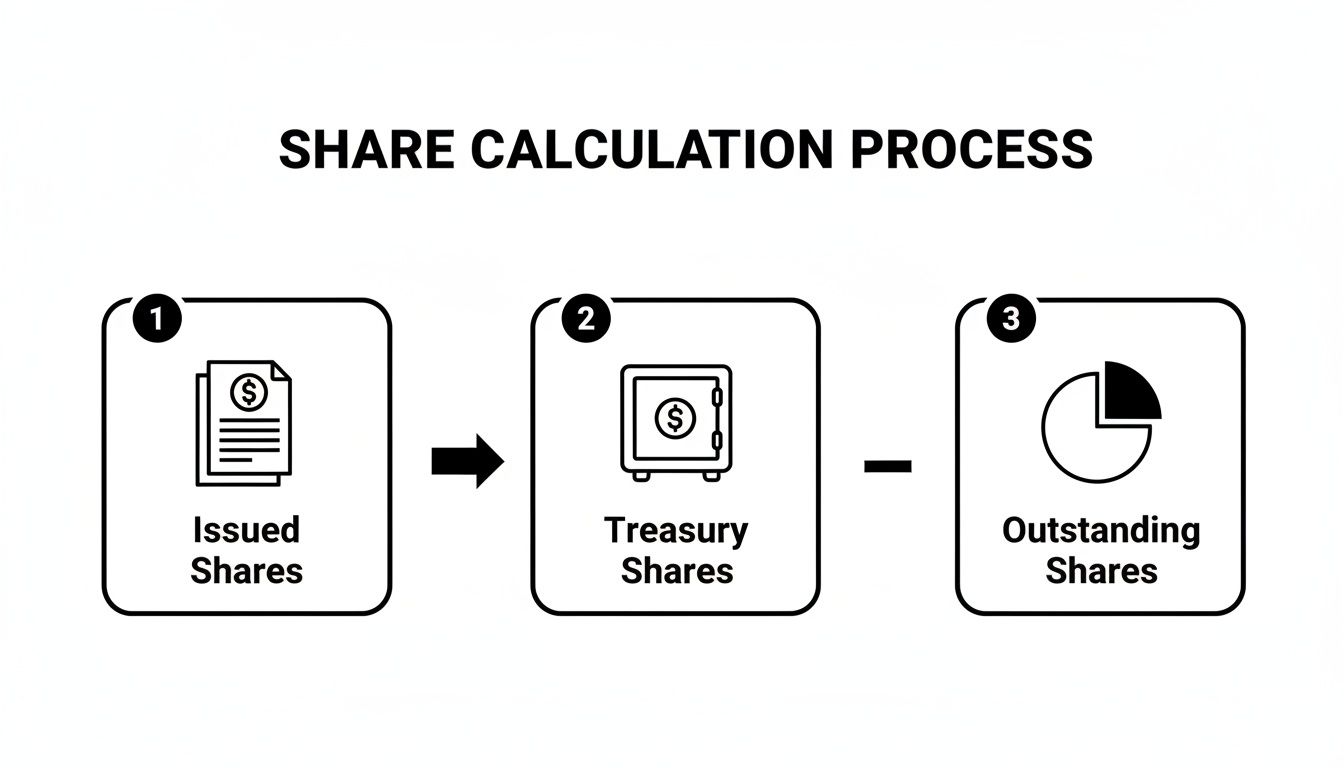
A diagram illustrates the share calculation process: Issued Shares minus Treasury Shares equals Outstanding Shares.

This just reinforces that you have to subtract treasury stock from the total issued shares to get your baseline number before you even start thinking about dilution.

Common Sources of Share Dilution

So, where do all these potential new shares come from? They don’t just appear out of thin air. They’re tied to specific financial instruments the company has issued over time.

While there are many potential sources, a few usual suspects are responsible for most share dilution.

Security Type Description Impact on Share Count
Stock Options Gives the holder (often an employee) the right to buy company stock at a set “strike” price. Increases share count when employees exercise their options to buy stock.
Warrants Similar to options but usually issued to investors. Grants the right to buy shares at a specific price before a certain date. Adds to the share count if the stock’s market price rises above the warrant’s exercise price.
Convertible Bonds A form of debt that bondholders can convert into a predetermined number of common shares. New shares are created when bondholders choose to convert their debt into equity.
Restricted Stock Units (RSUs) A company’s promise to grant an employee shares at a future date, once certain conditions are met (like vesting periods). Increases the share count as RSUs vest and are converted into actual shares.

Each of these instruments can add to the total share count if they are exercised or converted, which is why we can’t just ignore them.

So, how do we account for all this? The most accepted approach is something called the Treasury Stock Method. The core idea is that you assume the company uses the cash it gets from employees exercising their options to buy back its own shares on the open market.

The net effect-the brand-new shares created minus the shares the company bought back-is what gets added to the basic share count. This method is crucial because it stops you from just adding all potential shares from options, which would seriously overstate the real level of dilution. It’s a much more realistic way to model what a company would likely do with that cash inflow.

How Share Counts Impact Key Financial Ratios

Once you’ve nailed down the basic and diluted share counts, the real fun begins. That number isn’t just a random figure on a financial statement; it’s a powerful lever that directly moves some of the most important financial ratios that investors live and breathe by.

Understanding this connection is what separates a novice from an experienced analyst. It’s the difference between just finding a number and truly grasping what it means for a company’s story.

The most obvious place you’ll see the share count in action is a company’s total valuation. You simply can’t figure out what the market thinks a business is worth without it. We get into the nitty-gritty of this in our guide on what is market capitalization, but the formula itself-Share Price × Outstanding Shares-tells you everything you need to know. Tweak the share count, and the market cap figure moves right along with it.

The Direct Effect on Earnings Per Share

But where the share count really shows its muscle is with Earnings Per Share (EPS). This is one of the top metrics for gauging a company’s profitability on a per-share basis. The calculation is dead simple: Net Income / Outstanding Shares.

Because of this direct relationship, corporate actions that change the share count can have a massive effect on EPS, often without the company’s core business performance changing one bit.

Think about a share buyback. A company uses its cash to buy its own stock from the open market, which reduces the number of shares floating around. If net income holds steady, the EPS number automatically goes up. To a casual observer, the company suddenly looks more profitable, even though it hasn’t earned a single extra dollar.

On the flip side, imagine a company issues a ton of new stock to raise cash for a new project. This inflates the total outstanding shares. Even if the company’s net income grows by a respectable 10%, a 15% jump in the share count will actually drag its EPS down. Each shareholder’s slice of the profit pie just got smaller.

This is precisely why a smart investor always digs deeper when they see EPS move. Is it climbing because profits are genuinely growing, or is it just financial engineering from a shrinking share count? Knowing the difference is crucial to avoid being fooled by the headline numbers.

The Ripple Effect on Valuation Ratios

This influence doesn’t stop at EPS. It ripples out to other key valuation multiples, like the famous Price-to-Earnings (P/E) ratio.

The P/E ratio is calculated as Share Price / EPS. Since the number of outstanding shares is a key ingredient in the EPS calculation, it indirectly sways the P/E ratio, too. That share buyback we mentioned? By boosting EPS, it will also push the P/E ratio lower, which can make the stock appear cheaper and more attractive to value investors.

Understanding these mechanics is universal, whether you’re looking at a tech startup in Silicon Valley or a massive conglomerate in Tokyo. It’s a fundamental piece of the puzzle for comparing companies and assessing true market size, which is a massive global game involving $134.7 trillion in foreign U.S. securities transactions.

Common Questions About Calculating Outstanding Shares

Even with the formulas down, you’re bound to hit a few snags when you’re deep in an analysis. Calculating outstanding shares can sometimes feel like trying to hit a moving target, especially when different websites show conflicting data. Let’s clear up some of the most common points of confusion.

We’ll tackle the frequent questions that pop up, giving you the confidence to navigate these tricky situations and trust your own findings.

What Is the Difference Between Float and Outstanding Shares

This one comes up all the time. While they’re related, float and outstanding shares measure two very different things. Think of outstanding shares as the entire pie of a company’s stock-every single share held by every single shareholder.

This includes shares held by:

  • Large institutional investors like mutual funds and pension funds.
  • Company executives and insiders (often called restricted shares).
  • The general public, like you and me.

The float, on the other hand, is just a slice of that pie. It represents only the shares that are unrestricted and readily available for trading on the open market. It strips out the huge blocks of stock held by insiders, governments, and other controlling entities that aren’t expected to be sold anytime soon. For day traders, float is a huge deal for assessing liquidity, but for long-term valuation, outstanding shares are what really matter.

How Often Does the Share Count Actually Change

The number of outstanding shares isn’t set in stone; it’s constantly in flux. A company’s share count can change every quarter, or even more frequently, depending on corporate actions.

A share buyback is one of the most common culprits. When a company repurchases its own stock from the market, it reduces the number of shares outstanding. On the flip side, when a company issues new stock-either to raise cash or for employee compensation plans-the share count goes up. This is precisely why you have to pull your numbers from the most recent financial filing, like a 10-Q or 10-K.

An outdated share count is a recipe for an inaccurate valuation. I’ve seen investors mistakenly use a year-old number, completely missing the dilutive effect of a recent stock offering and overvaluing the company as a result.

Why Do Different Financial Websites Show Different Numbers

You’ve probably run into this yourself. You check Yahoo Finance, then Bloomberg, and maybe another data provider, and they all report slightly different numbers for the same company’s outstanding shares. It’s frustrating, but there’s a good reason for it.

The discrepancy usually boils down to timing and methodology.

  1. Timing of Updates: Some data providers refresh their figures daily, while others might do it weekly or only after a new quarterly report is filed. There’s always a lag.
  2. Data Source: Most sites pull data from automated feeds, but some apply their own adjustments or use different primary sources, leading to small variations.
  3. Basic vs. Diluted: One site might be reporting basic shares by default, while another shows the fully diluted count without making it obvious.

This is exactly why learning to pull the number directly from the primary source-the company’s own SEC filings-is such a critical skill. It makes you the authority, so you’re not at the mercy of third-party data lags or inconsistencies.


Ready to stop relying on inconsistent data and start performing your own accurate analysis? Finzer provides the tools you need to screen, compare, and track companies with confidence. Our platform simplifies complex financial data, empowering you to make informed investment choices. Explore the platform and take control of your research at https://finzer.io.

<p>Before you can figure out what a company is truly worth, you have to get a handle on its outstanding shares. It’s a simple concept on the surface: this is the total number of shares a company has issued that are currently held by all its shareholders. This includes big institutional investors and restricted shares held by company insiders.</p> <p>This number is the bedrock for calculating critical metrics like <strong>market capitalization</strong> and <em>Earnings Per Share (EPS)</em>.</p> <h2>Why Outstanding Shares Are a Critical Valuation Metric</h2> <p>Honestly, if you&#8217;re serious about investing, you can&#8217;t ignore the share count. Without it, you’re flying blind. It’s like knowing a slice of pizza costs $5 but having no idea how many slices are in the whole pie. You can&#8217;t tell if you&#8217;re getting a good deal.</p> <p>Let&#8217;s look at a quick example. Imagine two tech startups, Innovate Corp and Future Tech, both trading at <strong>$50</strong> per share. At a glance, they might seem equally valuable.</p> <p>But if Innovate Corp has <strong>20 million</strong> shares outstanding, its market cap is a cool <strong>$1 billion</strong>. Future Tech, on the other hand, might have <strong>200 million</strong> shares out there, pushing its market cap to a much heftier <strong>$10 billion</strong>.</p> <p>That simple difference highlights a crucial lesson: the share price alone is almost meaningless without context. The number of outstanding shares tells you the real scale of the business.</p> <h3>The Foundation of Fair Comparison</h3> <p>Figuring out the outstanding shares is the first real step in valuing a company, since it feeds directly into the market capitalization formula. Without it, you can&#8217;t compare apples to apples. And the scale of this is massive-the global equity market cap recently hit an eye-watering <strong>$126.7 trillion</strong>, an <strong>8.7%</strong> jump year-over-year. You can dig into the full details in <a href="https://www.sifma.org/resources/research/fact-book/">SIFMA&#8217;s Capital Markets Fact Book</a>.</p> <p>This isn&#8217;t just a number on a spreadsheet; it represents real ownership. Each share is a tiny slice of the company. The more shares there are, the more slices the ownership pie is cut into, which can dilute the value and earnings tied to your individual shares.</p> <blockquote><p>In my experience, overlooking the share count is one of the most common-and costly-mistakes I see new investors make. It’s so easy to get mesmerized by a rising stock price, but if the company is busy issuing millions of new shares behind the scenes, your personal stake in the business is actually shrinking.</p></blockquote> <h3>Setting the Stage for Deeper Analysis</h3> <p>Ultimately, mastering the outstanding shares calculation is your gateway to more sophisticated financial analysis. It’s the denominator in the all-important Earnings Per Share (EPS) formula, which is a key indicator of a company’s profitability.</p> <ul> <li><strong>Market Capitalization</strong> = Share Price x Outstanding Shares</li> <li><strong>Earnings Per Share (EPS)</strong> = Net Income / Outstanding Shares</li> </ul> <p>As you can see, getting the share count wrong throws off all your subsequent valuation work. Throughout this guide, we&#8217;ll break down exactly how to find this number and calculate it with precision, so you can be confident your investment decisions are built on a rock-solid foundation.</p> <h2>Where to Find Share Data in SEC Filings</h2> <p>Before you start crunching any numbers, your first stop should always be the company&#8217;s official filings with the Securities and Exchange Commission (SEC). Forget third-party financial sites for a moment. SEC documents are the ground truth, raw and unfiltered.</p> <p>For our purposes, the two most important reports are the annual <strong>10-K</strong> and the quarterly <strong>10-Q</strong>. I know these filings can look intimidatingly dense, but you don&#8217;t need to read them cover to cover. You just need to know where to look.</p> <h3>The Cover Page Shortcut</h3> <p>Want the quickest answer? Go straight to the cover page of the latest 10-K or 10-Q. Companies are required to disclose the number of shares outstanding as of the most recent practicable date, and they usually list it right near the top.</p> <p>This gives you a fantastic, up-to-date snapshot. But it&#8217;s just that-a snapshot. To really understand the full picture and build an accurate calculation, you’ll want to dig just a little bit deeper into the financial statements themselves.</p> <h3>Diving Into the Balance Sheet</h3> <p>The Consolidated Balance Sheet is where you&#8217;ll find the puzzle pieces to verify the share count. Your target is the &#8220;Stockholders&#8217; Equity&#8221; section. Here, you&#8217;ll find a few key line items:</p> <ul> <li><strong>Common Stock:</strong> This usually tells you the par value along with the number of shares authorized and, most importantly, <em>issued</em>.</li> <li><strong>Treasury Stock:</strong> This is the big one. It represents shares the company has bought back from the open market. These shares are technically issued, but they are <em>not</em> outstanding.</li> </ul> <p>This is a critical distinction. <strong>Issued shares</strong> are all the shares a company has ever sold to the public. <strong>Outstanding shares</strong>, the number we actually care about, are the issued shares <em>minus</em> any treasury stock the company holds.</p> <blockquote><p>My personal tip is to always cross-reference the cover page number with what you can piece together from the balance sheet. If there&#8217;s a small discrepancy, it’s usually because the cover page figure is more recent. Understanding <em>why</em> they differ is what separates a quick check from a thorough analysis.</p></blockquote> <p>Getting comfortable with these documents is a fundamental skill. If you want to build a solid foundation, our guide on <a href="https://finzer.io/en/blog/how-to-read-earnings-reports">how to read earnings reports</a> is a great place to start. And remember, beyond just SEC filings, companies often publish various financial reports for investors that can also contain this data. Once you know exactly where to look, you can gather the inputs for your calculations with complete confidence.</p> <h2>Calculating Basic Outstanding Shares With a Real Example</h2> <p>Alright, let&#8217;s get our hands dirty and move from theory to practice. Calculating basic outstanding shares is pretty simple once you know where to look for the numbers and what formula to use. Running through it once will give you the confidence to do this crucial step on your own.</p> <p>The core formula you need is this:</p> <p><strong>Issued Shares &#8211; Treasury Shares = Basic Outstanding Shares</strong></p> <p>This little equation is your starting point. The real work isn&#8217;t the math; it&#8217;s digging up the two inputs-issued shares and treasury shares-directly from a company&#8217;s financial reports.</p> <h3>Finding the Data and Running the Numbers</h3> <p>Your go-to source is always going to be the company&#8217;s latest 10-K (annual) or 10-Q (quarterly) report. You can find these for free on the SEC&#8217;s <a href="https://www.sec.gov/edgar/searchedgar/companysearch">EDGAR database</a>. The gold is usually buried in the &#8220;Stockholders&#8217; Equity&#8221; section of the Consolidated Balance Sheet.</p> <p>Let&#8217;s walk through an example with a made-up company, &#8220;Global Tech Inc.&#8221;</p> <p>Imagine you pull up Global Tech’s newest 10-Q. You scroll down to the balance sheet and find the following lines under Stockholders&#8217; Equity:</p> <ul> <li><strong>Common Stock:</strong> 1,200,000,000 shares issued</li> <li><strong>Treasury Stock:</strong> 150,000,000 shares, at cost</li> </ul> <p>With these two numbers in hand, the calculation is a piece of cake:</p> <p>1,200,000,000 (Issued Shares) &#8211; 150,000,000 (Treasury Shares) = <strong>1,050,000,000 Basic Outstanding Shares</strong></p> <p>That final number, <strong>1.05 billion</strong>, is exactly what you&#8217;d use to calculate Global Tech’s market capitalization or its basic Earnings Per Share (EPS).</p> <p>Here’s a look at the SEC&#8217;s EDGAR search page, your main portal for finding these critical documents.</p> <p>Just type a company&#8217;s name or ticker symbol into that search bar, and you&#8217;ll get access to all its public filings, including the 10-K and 10-Q reports you need.</p> <h3>Common Pitfalls to Avoid</h3> <p>The math might be easy, but I&#8217;ve seen plenty of investors stumble over small mistakes that lead to big valuation errors. Watch out for these common slip-ups:</p> <ul> <li><strong>Ignoring Treasury Stock:</strong> A classic mistake is just grabbing the &#8220;issued shares&#8221; number. If you don&#8217;t subtract treasury shares, you&#8217;ll inflate the share count and make metrics like EPS look artificially worse than they are.</li> <li><strong>Using Outdated Filings:</strong> Share counts are always in flux. Always, <em>always</em> use the most recent 10-K or 10-Q to make sure your data is fresh.</li> <li><strong>Confusing Authorized Shares with Issued Shares:</strong> Don&#8217;t get tripped up by the &#8220;authorized&#8221; number. That&#8217;s just the maximum number of shares a company <em>can</em> issue, not how many it <em>has</em> issued. It&#8217;s irrelevant for this calculation.</li> </ul> <blockquote><p>The key takeaway here is that precision is everything. The number of outstanding shares isn&#8217;t set in stone; it shifts with corporate actions like stock buybacks or new issuances. Always double-check your source and the date of the filing.</p></blockquote> <p>These changes can have a massive impact. A perfect real-world example unfolded during the 2008 financial crisis when U.S. banks like JPMorgan Chase saw their share counts change dramatically. Before the crisis in 2007, JPMorgan had about <strong>3.3 billion</strong> shares outstanding. By 2009, after bailouts and acquisitions, that number had swelled to around <strong>3.8 billion</strong>. This dilution completely altered its market dynamics. You can find more insights into share count history and its effects on various companies over time.</p> <h2>Understanding Diluted Shares for a Fuller Picture</h2> <p>Once you’ve got a handle on the basic outstanding share count, it&#8217;s time to dig a little deeper. The basic number gives you a snapshot of the company <em>today</em>, but it doesn&#8217;t tell you the whole story about what might happen <em>tomorrow</em>. Companies often have financial instruments floating around that could create a flood of new shares in the future, potentially watering down your ownership stake.</p> <p>This is exactly where <strong>diluted outstanding shares</strong> come into play. This calculation gives you a more conservative, forward-looking view by acting as if all securities that <em>can</em> be turned into common stock <em>have been</em>. Think of it as a &#8220;what-if&#8221; scenario that braces you for the maximum possible number of shares out there.</p> <h3>Why Dilution Matters to Investors</h3> <p>Share dilution is what happens when a company issues new equity, shrinking the ownership percentage of existing stockholders. It&#8217;s not always a bad sign-companies often do it to raise cash for growth projects. But it&#8217;s definitely something you need to keep on your radar.</p> <p>If you ignore potential dilution, you&#8217;re likely overestimating your claim on the company&#8217;s future profits. A company might report fantastic earnings, but if the share count suddenly balloons, the <a href="https://finzer.io/en/blog/what-is-earnings-per-share">earnings per share (EPS)</a> will take a hit. Looking at diluted shares gives you a much clearer sense of this potential impact.</p> <p>The starting point for any dilution analysis is the basic outstanding share count, which is what&#8217;s left after accounting for shares the company has bought back.</p> <figure class="wp-block-image size-large"><img data-recalc-dims="1" decoding="async" src="https://i0.wp.com/cdn.outrank.so/6540ba8a-af29-418a-9ef5-c1e2a673f1e1/22fe17fa-4993-49e7-8f71-bc79eeb37dc6/calculating-outstanding-shares-share-calculation.jpg?ssl=1" alt="A diagram illustrates the share calculation process: Issued Shares minus Treasury Shares equals Outstanding Shares." /></figure> <p>This just reinforces that you have to subtract treasury stock from the total issued shares to get your baseline number before you even start thinking about dilution.</p> <h3>Common Sources of Share Dilution</h3> <p>So, where do all these potential new shares come from? They don&#8217;t just appear out of thin air. They’re tied to specific financial instruments the company has issued over time.</p> <p>While there are many potential sources, a few usual suspects are responsible for most share dilution.</p> <table> <thead> <tr> <th align="left">Security Type</th> <th align="left">Description</th> <th align="left">Impact on Share Count</th> </tr> </thead> <tbody> <tr> <td align="left"><strong>Stock Options</strong></td> <td align="left">Gives the holder (often an employee) the right to buy company stock at a set &#8220;strike&#8221; price.</td> <td align="left">Increases share count when employees exercise their options to buy stock.</td> </tr> <tr> <td align="left"><strong>Warrants</strong></td> <td align="left">Similar to options but usually issued to investors. Grants the right to buy shares at a specific price before a certain date.</td> <td align="left">Adds to the share count if the stock&#8217;s market price rises above the warrant&#8217;s exercise price.</td> </tr> <tr> <td align="left"><strong>Convertible Bonds</strong></td> <td align="left">A form of debt that bondholders can convert into a predetermined number of common shares.</td> <td align="left">New shares are created when bondholders choose to convert their debt into equity.</td> </tr> <tr> <td align="left"><strong>Restricted Stock Units (RSUs)</strong></td> <td align="left">A company&#8217;s promise to grant an employee shares at a future date, once certain conditions are met (like vesting periods).</td> <td align="left">Increases the share count as RSUs vest and are converted into actual shares.</td> </tr> </tbody> </table> <p>Each of these instruments can add to the total share count if they are exercised or converted, which is why we can&#8217;t just ignore them.</p> <p>So, how do we account for all this? The most accepted approach is something called the <strong>Treasury Stock Method</strong>. The core idea is that you assume the company uses the cash it gets from employees exercising their options to buy back its own shares on the open market.</p> <p>The net effect-the brand-new shares created minus the shares the company bought back-is what gets added to the basic share count. This method is crucial because it stops you from just adding all potential shares from options, which would seriously overstate the real level of dilution. It’s a much more realistic way to model what a company would likely do with that cash inflow.</p> <h2>How Share Counts Impact Key Financial Ratios</h2> <p>Once you&#8217;ve nailed down the basic and diluted share counts, the real fun begins. That number isn&#8217;t just a random figure on a financial statement; it&#8217;s a powerful lever that directly moves some of the most important <a href="https://docsbot.ai/articles/tag/financial-ratios">financial ratios</a> that investors live and breathe by.</p> <p>Understanding this connection is what separates a novice from an experienced analyst. It’s the difference between just finding a number and truly grasping what it means for a company&#8217;s story.</p> <p>The most obvious place you&#8217;ll see the share count in action is a company&#8217;s total valuation. You simply can&#8217;t figure out what the market thinks a business is worth without it. We get into the nitty-gritty of this in our guide on <a href="https://finzer.io/en/blog/what-is-market-capitalization">what is market capitalization</a>, but the formula itself-<strong>Share Price × Outstanding Shares</strong>-tells you everything you need to know. Tweak the share count, and the market cap figure moves right along with it.</p> <h3>The Direct Effect on Earnings Per Share</h3> <p>But where the share count <em>really</em> shows its muscle is with <strong>Earnings Per Share (EPS)</strong>. This is one of the top metrics for gauging a company’s profitability on a per-share basis. The calculation is dead simple: Net Income / Outstanding Shares.</p> <p>Because of this direct relationship, corporate actions that change the share count can have a massive effect on EPS, often without the company’s core business performance changing one bit.</p> <p>Think about a <strong>share buyback</strong>. A company uses its cash to buy its own stock from the open market, which reduces the number of shares floating around. If net income holds steady, the EPS number automatically goes up. To a casual observer, the company suddenly looks more profitable, even though it hasn&#8217;t earned a single extra dollar.</p> <p>On the flip side, imagine a company issues a ton of new stock to raise cash for a new project. This inflates the total outstanding shares. Even if the company’s net income grows by a respectable <strong>10%</strong>, a <strong>15%</strong> jump in the share count will actually drag its EPS down. Each shareholder&#8217;s slice of the profit pie just got smaller.</p> <blockquote><p>This is precisely why a smart investor always digs deeper when they see EPS move. Is it climbing because profits are genuinely growing, or is it just financial engineering from a shrinking share count? Knowing the difference is crucial to avoid being fooled by the headline numbers.</p></blockquote> <h3>The Ripple Effect on Valuation Ratios</h3> <p>This influence doesn&#8217;t stop at EPS. It ripples out to other key valuation multiples, like the famous <strong>Price-to-Earnings (P/E) ratio</strong>.</p> <p>The P/E ratio is calculated as Share Price / EPS. Since the number of outstanding shares is a key ingredient in the EPS calculation, it indirectly sways the P/E ratio, too. That share buyback we mentioned? By boosting EPS, it will also push the P/E ratio lower, which can make the stock appear cheaper and more attractive to value investors.</p> <p>Understanding these mechanics is universal, whether you&#8217;re looking at a tech startup in Silicon Valley or a massive conglomerate in Tokyo. It&#8217;s a fundamental piece of the puzzle for comparing companies and assessing true market size, which is a massive global game involving <strong>$134.7 trillion</strong> in foreign U.S. securities transactions.</p> <h2>Common Questions About Calculating Outstanding Shares</h2> <p>Even with the formulas down, you&#8217;re bound to hit a few snags when you&#8217;re deep in an analysis. Calculating outstanding shares can sometimes feel like trying to hit a moving target, especially when different websites show conflicting data. Let&#8217;s clear up some of the most common points of confusion.</p> <p>We&#8217;ll tackle the frequent questions that pop up, giving you the confidence to navigate these tricky situations and trust your own findings.</p> <h3>What Is the Difference Between Float and Outstanding Shares</h3> <p>This one comes up all the time. While they&#8217;re related, <strong>float</strong> and <strong>outstanding shares</strong> measure two very different things. Think of <strong>outstanding shares</strong> as the <em>entire</em> pie of a company&#8217;s stock-every single share held by every single shareholder.</p> <p>This includes shares held by:</p> <ul> <li>Large institutional investors like mutual funds and pension funds.</li> <li>Company executives and insiders (often called restricted shares).</li> <li>The general public, like you and me.</li> </ul> <p>The <strong>float</strong>, on the other hand, is just a slice of that pie. It represents only the shares that are unrestricted and readily available for trading on the open market. It strips out the huge blocks of stock held by insiders, governments, and other controlling entities that aren&#8217;t expected to be sold anytime soon. For day traders, float is a huge deal for assessing liquidity, but for long-term valuation, outstanding shares are what really matter.</p> <h3>How Often Does the Share Count Actually Change</h3> <p>The number of outstanding shares isn&#8217;t set in stone; it&#8217;s constantly in flux. A company’s share count can change every quarter, or even more frequently, depending on corporate actions.</p> <p>A <strong>share buyback</strong> is one of the most common culprits. When a company repurchases its own stock from the market, it reduces the number of shares outstanding. On the flip side, when a company issues new stock-either to raise cash or for employee compensation plans-the share count goes up. This is precisely why you have to pull your numbers from the most recent financial filing, like a 10-Q or 10-K.</p> <blockquote><p>An outdated share count is a recipe for an inaccurate valuation. I&#8217;ve seen investors mistakenly use a year-old number, completely missing the dilutive effect of a recent stock offering and overvaluing the company as a result.</p></blockquote> <h3>Why Do Different Financial Websites Show Different Numbers</h3> <p>You’ve probably run into this yourself. You check Yahoo Finance, then Bloomberg, and maybe another data provider, and they all report slightly different numbers for the same company&#8217;s outstanding shares. It’s frustrating, but there&#8217;s a good reason for it.</p> <p>The discrepancy usually boils down to timing and methodology.</p> <ol> <li><strong>Timing of Updates:</strong> Some data providers refresh their figures daily, while others might do it weekly or only after a new quarterly report is filed. There&#8217;s always a lag.</li> <li><strong>Data Source:</strong> Most sites pull data from automated feeds, but some apply their own adjustments or use different primary sources, leading to small variations.</li> <li><strong>Basic vs. Diluted:</strong> One site might be reporting basic shares by default, while another shows the fully diluted count without making it obvious.</li> </ol> <p>This is exactly why learning to pull the number directly from the primary source-the company&#8217;s own SEC filings-is such a critical skill. It makes you the authority, so you&#8217;re not at the mercy of third-party data lags or inconsistencies.</p> <hr /> <p>Ready to stop relying on inconsistent data and start performing your own accurate analysis? <strong>Finzer</strong> provides the tools you need to screen, compare, and track companies with confidence. Our platform simplifies complex financial data, empowering you to make informed investment choices. Explore the platform and take control of your research at <a href="https://finzer.io">https://finzer.io</a>.</p>

Maximize Your Investment Insights with Finzer

Explore powerful screening tools and discover smarter ways to analyze stocks.