How to Interpret Financial Statements A Guide for Smart Decisions
2025-12-18
To really interpret financial statements, you need to understand how the income statement, balance sheet, and cash flow statement all talk to each other. They’re not just separate documents; together, they tell a company’s complete financial story. This is about seeing the big picture-profitability, stability, and liquidity-not just staring at numbers in isolation. Getting this right turns raw data into intelligence you can actually use.
Your Starting Point for Financial Statement Analysis
Jumping into financial analysis can feel like you’re trying to drink from a firehose, but the core idea is pretty simple. You’re piecing together a puzzle to see the full picture of a company’s health. Each statement gives you a different angle, and the real insight comes from connecting the dots between them.
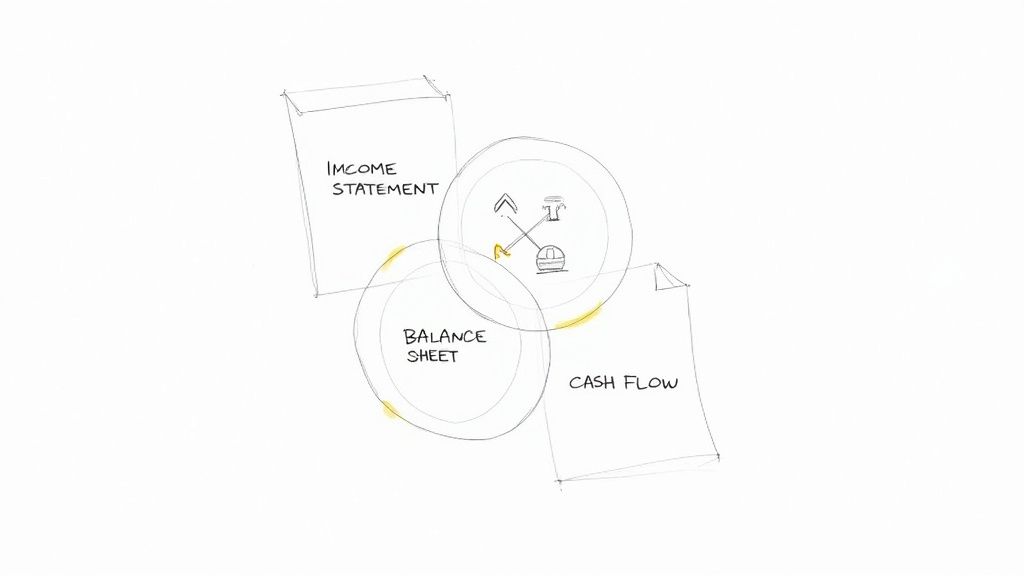
Think of it like a doctor giving a patient a check-up. One single test doesn’t tell the whole story. You need the combination of tests to get a full diagnosis.
The Three Core Statements
At the heart of any financial review are three key documents. Each one answers a different, fundamental question about the business.
- Income Statement: Also known as the Profit & Loss (P&L), this report shows a company’s performance over a period of time (like a quarter or a year). It answers the question, “Is this company actually making money?”
- Balance Sheet: This is a snapshot of the company’s financial position at a single point in time. It answers, “What does the company own, and what does it owe?” by balancing assets against liabilities and equity.
- Cash Flow Statement: This document tracks all the cash moving in and out of the business from its operations, investments, and financing. It answers the simple but critical question, “Where is the cash coming from, and where is it going?”
These statements are all linked. For instance, the net income from the income statement gets added to retained earnings on the balance sheet. Meanwhile, changes in balance sheet accounts like inventory or accounts receivable show up on the cash flow statement.
Key Takeaway: Don’t make the mistake of looking at just one statement. The real power comes from seeing how a transaction on one report ripples through the others. That’s how you get a dynamic, 360-degree view of the company.
Essential Analytical Techniques
To truly get what’s going on, you’ll need a few tools in your analytical toolbox. These methods help you dig deeper than the surface-level numbers and uncover trends that matter.
Here are the three foundational approaches I always use:
- Horizontal Analysis: This is all about comparing financial data over several periods. By looking at numbers from last year or even the last five years, you can spot growth trends, identify seasonal patterns, or catch potential red flags before they become major problems.
- Vertical Analysis: With this technique, you express each line item as a percentage of a base figure from the same period. On an income statement, for example, every expense is shown as a percentage of total revenue. This is a brilliant way to compare companies of different sizes or analyze structural shifts within a single business over time.
- Ratio Analysis: This is where you get into the nitty-gritty, calculating key metrics like the Current Ratio (to check liquidity) or the Debt-to-Equity Ratio (to gauge leverage). Ratios give you standardized measures that make it easy to compare a company against its industry peers and its own historical performance.
Of course, any analysis is only as good as the data you start with. Using modern accounting platforms is a huge help here. If you’re not familiar with them, checking out a strategic guide to cloud accounting solutions can give you a good sense of how they make data more robust and accessible.
Clean, well-organized data is the bedrock of good analysis. When you combine these statements and techniques, you stop just reading numbers and start understanding the story they’re telling.
Decoding Profitability with the Income Statement
If you want to know if a business is actually making money, the income statement is your first stop. It’s often called the Profit and Loss (P&L) statement, and it tells the story of a company’s financial performance over a specific time, like a quarter or a full year. Think of it as a report card showing whether revenues managed to outpace expenses.
This statement reads like a funnel. It starts with the biggest number-total revenue-at the top, then systematically subtracts all the costs and expenses until you hit the bottom line: net income. Getting a feel for this flow is crucial. Before you can really dig in, it helps to understand what a Profit and Loss (P&L) statement is and how itâs put together.
From Revenue to Gross Profit
The journey begins with Revenue, sometimes called “sales” or the “top line.” This is the total amount of money brought in from selling goods or services before a single expense is taken out. Itâs the starting point for everything.
Right after revenue, youâll see the Cost of Goods Sold (COGS). This number covers the direct costs of producing whatever the company sells, like raw materials and the labor needed to make the products. Subtracting COGS from revenue gives you a really important subtotal: Gross Profit.
Gross Profit = Revenue – Cost of Goods Sold
Gross profit tells you how much money the company makes from its core business before accounting for things like marketing or office salaries. It’s a raw measure of how efficiently it can produce and price its goods.
Uncovering Operating Income
Next, we start deducting the expenses needed to run the business day-to-day. These are the Operating Expenses, and they usually fall into a few key buckets:
- Selling, General & Administrative (SG&A): This is a catch-all for salaries, marketing, rent, and utilities.
- Research & Development (R&D): For companies that innovate, this is the cost of creating new products or improving old ones.
- Depreciation & Amortization: These are non-cash expenses that spread the cost of an asset (like a factory or a patent) over its useful life.
Once you subtract these operating costs from gross profit, you get Operating Income. This figure is incredibly insightful because it shows the profit generated purely from the company’s main business activities, stripping out the noise from interest and taxes.
The Bottom Line: Net Income
Finally, after operating income, the statement accounts for non-operating items like interest payments on debt and, of course, taxes. Once you factor those in, you arrive at the number everyone is waiting for: Net Income, the famous “bottom line.” This is the company’s total profit after every single expense has been paid.
Just knowing the line items isn’t enough, though. The real magic happens when you use these numbers to calculate profitability ratios. Our guide on how to read income statements goes much deeper into the structure and flow of this critical report.
Key Ratios for Deeper Insights
Ratios are what turn all those raw numbers into meaningful metrics. They let you compare a company’s performance against its own history or its competitors. For the income statement, there are a few must-know ratios that really tell a story.
I’ve put together a quick table summarizing the most important profitability ratios you’ll pull from the income statement.
| Ratio Name | Formula | What It Measures | Good Benchmark |
|---|---|---|---|
| Gross Profit Margin | (Gross Profit / Revenue) * 100 | The percentage of revenue left after covering direct production costs (COGS). | Varies by industry. Tech might see 40%+; retail is often 20-30%. |
| Operating Profit Margin | (Operating Income / Revenue) * 100 | Profitability from core business operations, before interest and taxes. | A stable or rising margin is ideal. Declining margins can be a red flag. |
| Net Profit Margin | (Net Income / Revenue) * 100 | The percentage of revenue that turns into pure profit (the bottom line). | Anything above 10% is generally considered good, but highly industry-dependent. |
| Return on Equity (ROE) | (Net Income / Shareholder Equity) * 100 | How effectively the company uses shareholder money to generate profit. | Consistently above 15% is a strong indicator of a quality business. |
These ratios give you a much clearer picture than just looking at the dollar amounts. They show you the why behind the numbers. Let’s look a little closer at two of the most telling ones.
Gross Profit Margin
This ratio, calculated as (Gross Profit / Revenue) * 100, shows the percentage of each dollar of revenue left over after paying for the goods themselves. A higher margin usually means the company has a strong competitive advantage, either because it can charge premium prices or because it’s incredibly efficient at production.
For example, a healthy margin in the tech industry might be above 40%, while a grocery store might operate in the low single digits. Consider Apple Inc., whose 2023 gross margin hit an impressive 44.1% on $383 billion in revenue-a clear sign of its powerful brand and tight cost controls.
Operating Profit Margin
Calculated as (Operating Income / Revenue) * 100, this ratio measures how much profit a company makes from its core operations for each dollar of sales. It’s a fantastic indicator of overall operational efficiency.
A declining operating margin, even while revenue is growing, can be a serious red flag. It might mean that operating costs are spinning out of control and the company is getting less efficient at turning sales into actual profit.
Assessing Stability with the Balance Sheet
If the income statement tells you about a company’s performance over a season, the balance sheet is a single, revealing snapshot. It captures the company’s financial position on one specific day-what it owns versus what it owes.
Everything on the balance sheet hinges on a simple, unbreakable rule: the fundamental accounting equation.
This isn’t just accounting theory; it’s the core of financial stability. The equation must always balance out. It means everything the company owns (Assets) has been paid for by either borrowing money (Liabilities) or through the owners’ investment (Equity).
Breaking Down the Accounting Equation
To really get a feel for a company’s financial health, you have to understand these three building blocks. Each one tells a vital part of the story.
- Assets: This is all the stuff the company owns that has economic value. It can be cash in the bank, inventory on the shelves, machinery, or even intangible things like patents and brand recognition.
- Liabilities: This is simply what the company owes. Think of it as claims outsiders have on the company’s assets, from short-term bills to suppliers (accounts payable) to hefty long-term bank loans.
- Equity: Also known as shareholders’ equity, this is whatâs left over for the owners after you subtract all the liabilities from the assets. Itâs the company’s net worth.
A company with a solid balance sheet will show a healthy relationship between these three. For a deeper dive into every line item, our guide on how to read a balance sheet is a great resource.
Current vs Non-Current Distinctions
Now, let’s get practical. The balance sheet isn’t just one big list; itâs cleverly organized into current and non-current (or long-term) categories for both assets and liabilities.
The magic number is one year. Current assets are resources the company expects to use or turn into cash within twelve months, like inventory or payments due from customers. Current liabilities are debts that need to be paid within that same year. This split is absolutely critical for figuring out if a company can survive the near future.
Expert Tip: Keep a sharp eye on the accounts receivable trend. If it’s ballooning faster than revenue, it might be a warning sign. It could mean the company is having a tough time collecting cash from its customers, which is a classic recipe for a liquidity crunch.
Measuring Short-Term Health with Liquidity Ratios
Can the company cover its immediate bills? Thatâs the core question liquidity ratios are designed to answer. They’re like a quick financial stress test for short-term survival.
The go-to metric here is the Current Ratio.
- Formula: Current Ratio = Current Assets / Current Liabilities
A ratio over 1.0 is the bare minimum, meaning there are more short-term assets than short-term debts. But a truly healthy range is often between 1.5 and 2.0. This suggests a comfortable buffer without having too much cash sitting idle in low-return assets.
Gauging Long-Term Risk with Solvency Ratios
While liquidity is about making it through the next year, solvency is about long-term endurance. Solvency ratios give you a window into a companyâs ability to handle its long-term debt, exposing its underlying financial risk.
The key solvency metric you need to watch is the Debt-to-Equity (D/E) Ratio.
- Formula: Debt-to-Equity Ratio = Total Liabilities / Shareholder’s Equity
This ratio tells you how much debt the company is using to run its operations compared to the amount of its own capital. A high D/E ratio signals that management has been aggressive with debt to fuel growth. This can create a lot of volatility, as those interest payments have to be made no matter what.
What counts as “high” depends heavily on the industry. A utility company might comfortably carry a D/E ratio of 2.0 or more, but a tech startup with a ratio over 1.0 might raise eyebrows. For instance, capital-heavy airlines saw average D/E ratios of 3.5x post-2020, while the tech sector stayed near 0.5x. At the other end of the spectrum, Berkshire Hathawayâs famously fortress-like balance sheet had a D/E of just 0.25 in 2023, a major factor in its journey to a $1 trillion valuation.
Tracking the Money with the Cash Flow Statement
An income statement might show a healthy profit, but that doesn’t always mean there’s cash in the bank. This is where the cash flow statement steps in, offering a hard look at a company’s actual liquidity. I’ve always lived by the old saying, “profit is an opinion, but cash is a fact.” This statement is the ultimate source of truth for where a company’s money is really coming from and where itâs going.
Itâs the report that connects the dots between the income statement and the balance sheet. Iâve seen countless business owners get confused when their P&L looks great, but their bank account is empty. The cash flow statement is what solves that mystery.
The Three Streams of Cash Flow
To really get what you’re looking at, you have to understand the three distinct sections of the cash flow statement. Each part tells a unique story about how a company is generating and using its cash.
- Cash from Operating Activities: This is the lifeblood of the business-the cash generated from its core operations. Think of it as the money that comes from selling products or services, minus the cash paid for day-to-day expenses like salaries, rent, and inventory. A healthy company should consistently generate positive cash flow here.
- Cash from Investing Activities: This section shows cash spent on or received from investments. This includes buying or selling long-term assets like property and equipment (you’ll see this as Capital Expenditures or CapEx), as well as acquiring or selling other businesses or securities.
- Cash from Financing Activities: This part details the flow of cash between a company and its owners and creditors. It covers activities like issuing or repurchasing stock, paying out dividends, and taking on or paying back debt.
These three streams paint a complete picture of a company’s financial movements. For a detailed breakdown of each section, our guide on cash flow statement analysis offers a deeper exploration.
Interpreting the Narrative Behind the Numbers
The numbers in each section tell a compelling story, but only if you know how to read them. For instance, a negative cash flow from investing isn’t automatically a red flag. For a growing company, it often means it’s heavily investing in new equipment or technology to fuel future expansion-a great sign.
On the other hand, a positive cash flow from financing might look good at first glance, but it could mean the company is taking on more debt or diluting ownership by issuing new stock just to stay afloat. The key is to look at these sections in context with one another.
Expert Insight: A major red flag for me is a company that consistently shows positive net income on its income statement but negative cash flow from operations. This mismatch can signal serious underlying issues, like problems collecting payments from customers or holding onto way too much inventory.
The Ultimate Metric: Free Cash Flow
One of the most powerful metrics you can pull from this statement is Free Cash Flow (FCF). This is the cash a company has left over after paying for its operating expenses and capital expenditures. This is the real cash available to pay down debt, distribute dividends, or reinvest in the business.
The formula is pretty straightforward:
Free Cash Flow = Cash from Operations – Capital Expenditures
A company with strong and growing FCF is often seen as financially robust and capable of weathering economic storms. It has the flexibility to jump on opportunities without having to rely on outside financing.
Why Cash Flow Reigns Supreme
The cash flow statement is so critical because it cuts right through the fluff of accrual accounting. By breaking down cash generation into operating, investing, and financing activities, it gives you a much better measure of a company’s true viability than just looking at profit.
A key health indicator is when Operating Cash Flow (OCF) exceeds net income. A ratio of 1.2x to 1.5x is a great sign of high-quality earnings. We learned this lesson the hard way from the WorldCom fraud in 2002, where the company reported huge profits while having negative OCF.
Remember, Free Cash Flow (FCF) is what actually funds things like dividends and buybacks. Take Apple, for example. Their staggering $99 billion in FCF in 2023 is what enabled them to fund $15 billion in share buybacks.
By mastering the cash flow statement, you move beyond surface-level profits. You gain a true understanding of a companyâs ability to generate and manage the one resource that matters most: cash.
Connecting the Dots for a Complete Financial Picture
Looking at financial statements one by one is a good start, but the real magic happens when you see how they all weave together. These documents aren’t islands; they’re deeply interconnected. A change on the balance sheet creates ripples on the cash flow statement, and the profit you see on the income statement is what builds equity over time.
Learning to read these statements as a single, cohesive story is what separates a novice from a seasoned financial analyst. Itâs about moving past isolated data points to grasp the full narrative of a company’s financial health.
This concept map is a great visual for breaking down the Cash Flow Statement into its three core activities: Operating, Investing, and Financing.
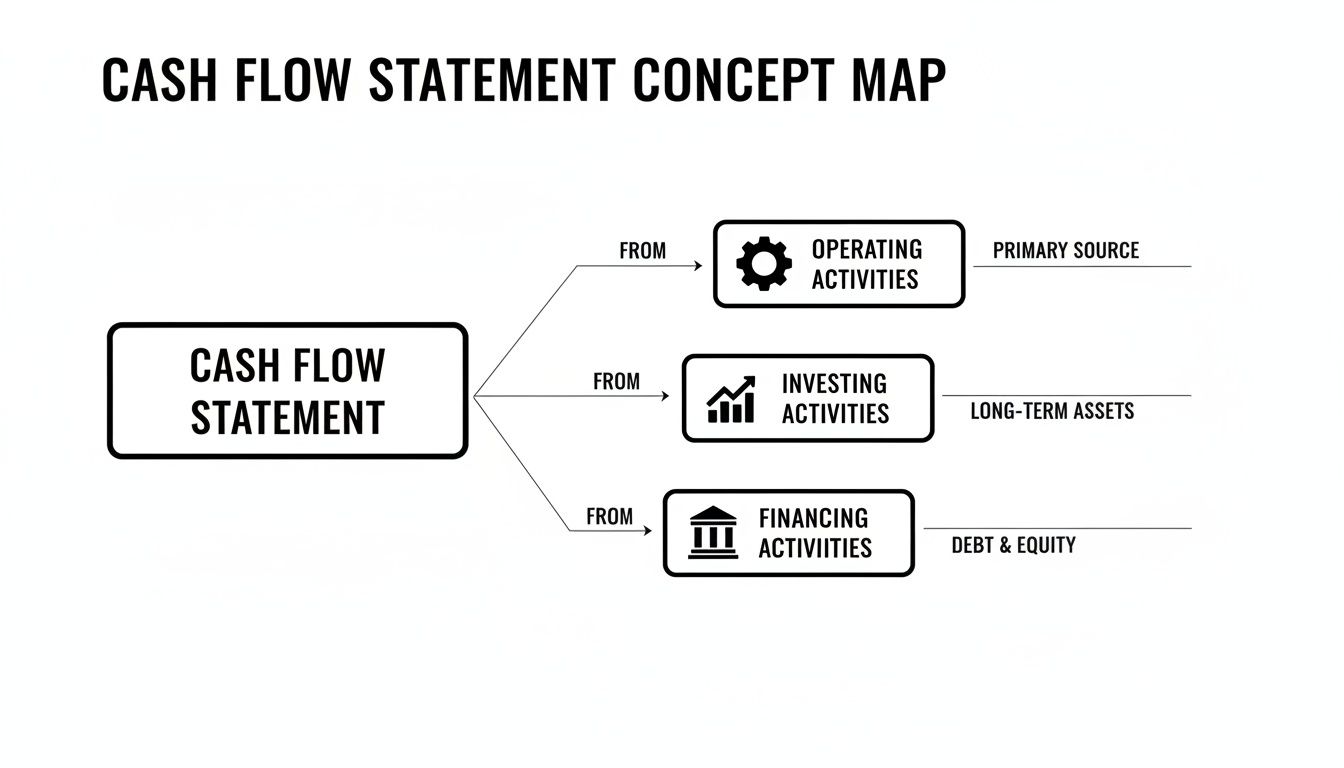
It perfectly illustrates how a company generates and uses cash-whether through its day-to-day business (operating), its plans for long-term growth (investing), or its dealings with owners and lenders (financing).
Uncovering the Story with Horizontal and Vertical Analysis
To truly see the bigger picture, two of the most powerful techniques you can use are horizontal and vertical analysis. They add crucial context to the raw numbers, helping you spot trends and structural shifts that youâd otherwise miss.
Horizontal Analysis (Trend Analysis)
This is all about comparing financial data across multiple periods, like quarter-over-quarter or, more commonly, year-over-year. By lining up a few years of income statements side-by-side, you can quickly see the story unfold.
- Is revenue growing steadily, or is it flatlining?
- Are operating expenses ballooning faster than sales?
- Whatâs the trend for net income over the last five years-up or down?
This long-term perspective is everything. A single great year is nice, but consistent performance over three to five years points to a much more resilient and well-managed business.
Vertical Analysis (Common-Size Analysis)
Vertical analysis, on the other hand, zooms in on the internal structure of a single statement. The trick is to express each line item as a percentage of a major figure from that same period.
- For the Income Statement: You show every item as a percentage of total revenue. This immediately tells you what slice of every dollar earned goes to cost of goods sold, what slice covers administrative expenses, and whatâs left over as pure profit.
- For the Balance Sheet: Each asset becomes a percentage of total assets, and each liability is shown as a percentage of total liabilities and equity.
This is a fantastic way to compare companies of different sizes. A small business pulling in $2 million in revenue can be compared fairly against a corporation with $200 million by simply looking at their expense percentages.
Go Deeper with DuPont Analysis
One of the most elegant tools for tying the statements together is the DuPont Analysis. This method deconstructs Return on Equity (ROE)-a critical profitability metric-into its three core drivers. It shows you how a company is actually generating its returns.
DuPont Formula: ROE = Net Profit Margin x Asset Turnover x Financial Leverage
This formula tells a far richer story than ROE alone. It reveals whether a company’s success is built on high profit margins, super-efficient use of its assets, or just by taking on a lot of debt.
Let’s quickly unpack the components:
- Profitability (Net Profit Margin): Pulled straight from the income statement, this shows how much profit the company squeezes from each dollar of sales.
- Asset Efficiency (Asset Turnover): This ratio (Sales / Total Assets) bridges the income statement and balance sheet, showing how well the company uses its assets to generate sales.
- Financial Leverage (Equity Multiplier): This ratio (Assets / Equity) comes from the balance sheet and reveals how much of the company’s asset base is financed with debt versus the owners’ capital.
When you break ROE down like this, you can pinpoint the real engine of performance. Two companies could have the same 15% ROE, but one might get there with high margins and low debt, while the other uses razor-thin margins and high leverage-a much riskier game. This is the kind of powerful insight you only get by connecting the dots.
Answering Your Lingering Questions About Financial Statements
Once you get the hang of the basics, you’ll find a few tricky questions always seem to surface. Nailing down the answers to these common sticking points is what really builds your confidence and makes your analysis hit the mark. Think of it as moving from just reading the notes to truly understanding the music.
Let’s unpack some of the most common points of confusion so you can start interpreting financial statements like a seasoned pro.
Why Do Ratios Look So Different Across Industries?
One of the first things that trips people up is seeing how a “good” ratio in one industry can spell disaster in another. A software company might boast a gross profit margin of 60%, while a supermarket chain could be thriving at just 3%. What gives?
It all boils down to the fundamental business model.
- Capital Intensity: Think about a heavy manufacturing company. They need massive, expensive factories and machinery (huge assets). This will naturally give them a much lower asset turnover ratio compared to a lean software firm that might only own laptops and office chairs.
- Operating Leverage: Airlines have enormous fixed costs-planes, airport fees, staff-regardless of how many passengers are on board. Their financial structure and risk profile are worlds away from a consulting firm with mostly variable costs.
- Sales Volume vs. Margin: This is a classic trade-off. Retailers like grocery stores live and die by selling massive quantities of products with tiny margins on each item. On the flip side, a luxury watchmaker sells very few units but makes a fortune on each one.
Key Takeaway: You can’t analyze a company in a vacuum. Context is king. Always, always benchmark a company’s ratios against its direct competitors and the wider industry averages. Thatâs the only way to get a real feel for how it’s actually performing.
How Can a Company Be Profitable but Still Go Bankrupt?
This is the million-dollar question, and itâs a critical one. The answer almost always comes down to one thing: the massive difference between profit and cash. An income statement can paint a rosy picture with a healthy net income, but if the company isn’t actually collecting cold, hard cash from its customers, it’s going to run out of money to pay its own bills.
This cash crunch often happens when:
- Aggressive Revenue Recognition: A company might record a sale the second a contract is signed, even if the payment isn’t due for another six months. The income statement looks great, but the bank account is empty.
- Skyrocketing Accounts Receivable: This is a huge red flag. It means customers are taking longer and longer to pay their bills, effectively using the company as a free bank and trapping cash needed for day-to-day operations.
- Piling Up Inventory: Every unsold product sitting in a warehouse is cash tied up on a shelf. Too much inventory means that money isn’t available for things like payroll, rent, or paying suppliers.
The cash flow statement is your ultimate reality check. If a company is posting big profits but its cash from operations is consistently in the red, something is seriously wrong under the hood.
What Are the Big Red Flags I Should Watch For?
Learning to spot the warning signs early can save you from a world of hurt, whether you’re investing or making a business decision.
Here are a few of the tell-tale red flags I always keep an eye out for:
- Shrinking Margins: If you see gross or operating margins getting thinner year after year, it’s a bad sign. It could mean the competition is eating their lunch, or that their costs are spiraling out of control.
- Revenue Growing Faster Than Cash Flow: This one is subtle but deadly. It suggests the company is great at making sales on paper but terrible at actually collecting the cash.
- Climbing Debt Levels: A debt-to-equity ratio that’s constantly on the rise is a major concern. It can show that a company is becoming too dependent on borrowing just to stay afloat, which adds a huge amount of risk.
Ready to move beyond spreadsheets and get AI-powered insights? Finzer provides a powerful analytics platform that simplifies complex financial data, helping you screen, compare, and track companies with confidence. Make smarter investment decisions today by visiting Finzer.
Find good stocks, faster.
Screen, compare, and track companies in one place. Our AI explains the numbers in plain English so you can invest with confidence.
<p>To really interpret financial statements, you need to understand how the <strong>income statement</strong>, <strong>balance sheet</strong>, and <strong>cash flow statement</strong> all talk to each other. They’re not just separate documents; together, they tell a company’s complete financial story. This is about seeing the big picture-profitability, stability, and liquidity-not just staring at numbers in isolation. Getting this right turns raw data into intelligence you can actually use.</p> <h2>Your Starting Point for Financial Statement Analysis</h2> <p>Jumping into financial analysis can feel like you’re trying to drink from a firehose, but the core idea is pretty simple. You’re piecing together a puzzle to see the full picture of a company’s health. Each statement gives you a different angle, and the real insight comes from connecting the dots between them.</p> <figure class="wp-block-image size-large"><img data-recalc-dims="1" decoding="async" src="https://i0.wp.com/cdn.outrank.so/6540ba8a-af29-418a-9ef5-c1e2a673f1e1/51402152-719e-4d7b-acda-2f0f58e0023e/how-to-interpret-financial-statements-interconnection.jpg?ssl=1" alt="Hand-drawn sketch illustrating the interconnectedness of Income Statement, Balance Sheet, and Cash Flow financial reports." /></figure> <p>Think of it like a doctor giving a patient a check-up. One single test doesn’t tell the whole story. You need the combination of tests to get a full diagnosis.</p> <h3>The Three Core Statements</h3> <p>At the heart of any financial review are three key documents. Each one answers a different, fundamental question about the business.</p> <ul> <li><strong>Income Statement:</strong> Also known as the Profit & Loss (P&L), this report shows a company’s performance <em>over a period of time</em> (like a quarter or a year). It answers the question, “Is this company actually making money?”</li> <li><strong>Balance Sheet:</strong> This is a snapshot of the company’s financial position <em>at a single point in time</em>. It answers, “What does the company own, and what does it owe?” by balancing assets against liabilities and equity.</li> <li><strong>Cash Flow Statement:</strong> This document tracks all the cash moving in and out of the business from its operations, investments, and financing. It answers the simple but critical question, “Where is the cash coming from, and where is it going?”</li> </ul> <p>These statements are all linked. For instance, the net income from the income statement gets added to retained earnings on the balance sheet. Meanwhile, changes in balance sheet accounts like inventory or accounts receivable show up on the cash flow statement.</p> <blockquote><p><strong>Key Takeaway:</strong> Don’t make the mistake of looking at just one statement. The real power comes from seeing how a transaction on one report ripples through the others. That’s how you get a dynamic, 360-degree view of the company.</p></blockquote> <h3>Essential Analytical Techniques</h3> <p>To truly get what’s going on, you’ll need a few tools in your analytical toolbox. These methods help you dig deeper than the surface-level numbers and uncover trends that matter.</p> <p>Here are the three foundational approaches I always use:</p> <ol> <li><strong>Horizontal Analysis:</strong> This is all about comparing financial data over several periods. By looking at numbers from last year or even the last five years, you can spot growth trends, identify seasonal patterns, or catch potential red flags before they become major problems.</li> <li><strong>Vertical Analysis:</strong> With this technique, you express each line item as a percentage of a base figure from the same period. On an income statement, for example, every expense is shown as a percentage of total revenue. This is a brilliant way to compare companies of different sizes or analyze structural shifts within a single business over time.</li> <li><strong>Ratio Analysis:</strong> This is where you get into the nitty-gritty, calculating key metrics like the Current Ratio (to check liquidity) or the Debt-to-Equity Ratio (to gauge leverage). Ratios give you standardized measures that make it easy to compare a company against its industry peers and its own historical performance.</li> </ol> <p>Of course, any analysis is only as good as the data you start with. Using modern accounting platforms is a huge help here. If you’re not familiar with them, checking out a <a href="https://cloudvara.com/cloud-accounting-solutions/">strategic guide to cloud accounting solutions</a> can give you a good sense of how they make data more robust and accessible.</p> <p>Clean, well-organized data is the bedrock of good analysis. When you combine these statements and techniques, you stop just reading numbers and start understanding the story they’re telling.</p> <h2>Decoding Profitability with the Income Statement</h2> <p>If you want to know if a business is actually making money, the income statement is your first stop. It’s often called the Profit and Loss (P&L) statement, and it tells the story of a company’s financial performance over a specific time, like a quarter or a full year. Think of it as a report card showing whether revenues managed to outpace expenses.</p> <p>This statement reads like a funnel. It starts with the biggest number-total revenue-at the top, then systematically subtracts all the costs and expenses until you hit the bottom line: <strong>net income</strong>. Getting a feel for this flow is crucial. Before you can really dig in, it helps to understand <a href="https://myofficeops.com/resources/what-is-a-profit-and-loss-statement/">what a Profit and Loss (P&L) statement is</a> and how itâs put together.</p> <h3>From Revenue to Gross Profit</h3> <p>The journey begins with <strong>Revenue</strong>, sometimes called “sales” or the “top line.” This is the total amount of money brought in from selling goods or services before a single expense is taken out. Itâs the starting point for everything.</p> <p>Right after revenue, youâll see the <strong>Cost of Goods Sold (COGS)</strong>. This number covers the direct costs of producing whatever the company sells, like raw materials and the labor needed to make the products. Subtracting COGS from revenue gives you a really important subtotal: <strong>Gross Profit</strong>.</p> <blockquote><p><strong>Gross Profit = Revenue – Cost of Goods Sold</strong></p></blockquote> <p>Gross profit tells you how much money the company makes from its core business before accounting for things like marketing or office salaries. It’s a raw measure of how efficiently it can produce and price its goods.</p> <h3>Uncovering Operating Income</h3> <p>Next, we start deducting the expenses needed to run the business day-to-day. These are the <strong>Operating Expenses</strong>, and they usually fall into a few key buckets:</p> <ul> <li><strong>Selling, General & Administrative (SG&A):</strong> This is a catch-all for salaries, marketing, rent, and utilities.</li> <li><strong>Research & Development (R&D):</strong> For companies that innovate, this is the cost of creating new products or improving old ones.</li> <li><strong>Depreciation & Amortization:</strong> These are non-cash expenses that spread the cost of an asset (like a factory or a patent) over its useful life.</li> </ul> <p>Once you subtract these operating costs from gross profit, you get <strong>Operating Income</strong>. This figure is incredibly insightful because it shows the profit generated purely from the company’s main business activities, stripping out the noise from interest and taxes.</p> <h3>The Bottom Line: Net Income</h3> <p>Finally, after operating income, the statement accounts for non-operating items like interest payments on debt and, of course, taxes. Once you factor those in, you arrive at the number everyone is waiting for: <strong>Net Income</strong>, the famous “bottom line.” This is the company’s total profit after <em>every single expense</em> has been paid.</p> <p>Just knowing the line items isn’t enough, though. The real magic happens when you use these numbers to calculate profitability ratios. Our guide on <a href="https://finzer.io/en/blog/how-to-read-income-statements">how to read income statements</a> goes much deeper into the structure and flow of this critical report.</p> <h3>Key Ratios for Deeper Insights</h3> <p>Ratios are what turn all those raw numbers into meaningful metrics. They let you compare a company’s performance against its own history or its competitors. For the income statement, there are a few must-know ratios that really tell a story.</p> <p>I’ve put together a quick table summarizing the most important profitability ratios you’ll pull from the income statement.</p> <table> <thead> <tr> <th align="left">Ratio Name</th> <th align="left">Formula</th> <th align="left">What It Measures</th> <th align="left">Good Benchmark</th> </tr> </thead> <tbody> <tr> <td align="left"><strong>Gross Profit Margin</strong></td> <td align="left">(Gross Profit / Revenue) * 100</td> <td align="left">The percentage of revenue left after covering direct production costs (COGS).</td> <td align="left">Varies by industry. Tech might see <strong>40%+</strong>; retail is often <strong>20-30%</strong>.</td> </tr> <tr> <td align="left"><strong>Operating Profit Margin</strong></td> <td align="left">(Operating Income / Revenue) * 100</td> <td align="left">Profitability from core business operations, before interest and taxes.</td> <td align="left">A stable or rising margin is ideal. Declining margins can be a red flag.</td> </tr> <tr> <td align="left"><strong>Net Profit Margin</strong></td> <td align="left">(Net Income / Revenue) * 100</td> <td align="left">The percentage of revenue that turns into pure profit (the bottom line).</td> <td align="left">Anything above <strong>10%</strong> is generally considered good, but highly industry-dependent.</td> </tr> <tr> <td align="left"><strong>Return on Equity (ROE)</strong></td> <td align="left">(Net Income / Shareholder Equity) * 100</td> <td align="left">How effectively the company uses shareholder money to generate profit.</td> <td align="left">Consistently above <strong>15%</strong> is a strong indicator of a quality business.</td> </tr> </tbody> </table> <p>These ratios give you a much clearer picture than just looking at the dollar amounts. They show you the <em>why</em> behind the numbers. Let’s look a little closer at two of the most telling ones.</p> <h4>Gross Profit Margin</h4> <p>This ratio, calculated as <code>(Gross Profit / Revenue) * 100</code>, shows the percentage of each dollar of revenue left over after paying for the goods themselves. A higher margin usually means the company has a strong competitive advantage, either because it can charge premium prices or because it’s incredibly efficient at production.</p> <p>For example, a healthy margin in the tech industry might be above <strong>40%</strong>, while a grocery store might operate in the low single digits. Consider Apple Inc., whose 2023 gross margin hit an impressive <strong>44.1%</strong> on <strong>$383 billion</strong> in revenue-a clear sign of its powerful brand and tight cost controls.</p> <h4>Operating Profit Margin</h4> <p>Calculated as <code>(Operating Income / Revenue) * 100</code>, this ratio measures how much profit a company makes from its core operations for each dollar of sales. It’s a fantastic indicator of overall operational efficiency.</p> <p>A declining operating margin, even while revenue is growing, can be a serious red flag. It might mean that operating costs are spinning out of control and the company is getting less efficient at turning sales into actual profit.</p> <h2>Assessing Stability with the Balance Sheet</h2> <p>If the income statement tells you about a company’s performance over a season, the balance sheet is a single, revealing snapshot. It captures the company’s financial position on one specific day-what it owns versus what it owes.</p> <p>Everything on the balance sheet hinges on a simple, unbreakable rule: the fundamental accounting equation.</p> <p>This isn’t just accounting theory; it’s the core of financial stability. The equation must always balance out. It means everything the company owns (<strong>Assets</strong>) has been paid for by either borrowing money (<strong>Liabilities</strong>) or through the owners’ investment (<strong>Equity</strong>).</p> <h3>Breaking Down the Accounting Equation</h3> <p>To really get a feel for a company’s financial health, you have to understand these three building blocks. Each one tells a vital part of the story.</p> <ul> <li><strong>Assets:</strong> This is all the stuff the company owns that has economic value. It can be cash in the bank, inventory on the shelves, machinery, or even intangible things like patents and brand recognition.</li> <li><strong>Liabilities:</strong> This is simply what the company owes. Think of it as claims outsiders have on the company’s assets, from short-term bills to suppliers (<strong>accounts payable</strong>) to hefty long-term bank loans.</li> <li><strong>Equity:</strong> Also known as <strong>shareholders’ equity</strong>, this is whatâs left over for the owners after you subtract all the liabilities from the assets. Itâs the company’s net worth.</li> </ul> <p>A company with a solid balance sheet will show a healthy relationship between these three. For a deeper dive into every line item, our guide on <a href="https://finzer.io/en/blog/how-to-read-a-balance-sheet">how to read a balance sheet</a> is a great resource.</p> <h3>Current vs Non-Current Distinctions</h3> <p>Now, let’s get practical. The balance sheet isn’t just one big list; itâs cleverly organized into <strong>current</strong> and <strong>non-current</strong> (or long-term) categories for both assets and liabilities.</p> <p>The magic number is one year. <strong>Current assets</strong> are resources the company expects to use or turn into cash within twelve months, like inventory or payments due from customers. <strong>Current liabilities</strong> are debts that need to be paid within that same year. This split is absolutely critical for figuring out if a company can survive the near future.</p> <blockquote><p><strong>Expert Tip:</strong> Keep a sharp eye on the <strong>accounts receivable</strong> trend. If it’s ballooning faster than revenue, it might be a warning sign. It could mean the company is having a tough time collecting cash from its customers, which is a classic recipe for a liquidity crunch.</p></blockquote> <h3>Measuring Short-Term Health with Liquidity Ratios</h3> <p>Can the company cover its immediate bills? Thatâs the core question liquidity ratios are designed to answer. They’re like a quick financial stress test for short-term survival.</p> <p>The go-to metric here is the <strong>Current Ratio</strong>.</p> <ul> <li><strong>Formula:</strong> Current Ratio = Current Assets / Current Liabilities</li> </ul> <p>A ratio over <strong>1.0</strong> is the bare minimum, meaning there are more short-term assets than short-term debts. But a truly healthy range is often between <strong>1.5 and 2.0</strong>. This suggests a comfortable buffer without having too much cash sitting idle in low-return assets.</p> <h3>Gauging Long-Term Risk with Solvency Ratios</h3> <p>While liquidity is about making it through the next year, solvency is about long-term endurance. Solvency ratios give you a window into a companyâs ability to handle its long-term debt, exposing its underlying financial risk.</p> <p>The key solvency metric you need to watch is the <strong>Debt-to-Equity (D/E) Ratio</strong>.</p> <ul> <li><strong>Formula:</strong> Debt-to-Equity Ratio = Total Liabilities / Shareholder’s Equity</li> </ul> <p>This ratio tells you how much debt the company is using to run its operations compared to the amount of its own capital. A high D/E ratio signals that management has been aggressive with debt to fuel growth. This can create a lot of volatility, as those interest payments have to be made no matter what.</p> <p>What counts as “high” depends heavily on the industry. A utility company might comfortably carry a D/E ratio of <strong>2.0</strong> or more, but a tech startup with a ratio over <strong>1.0</strong> might raise eyebrows. For instance, capital-heavy airlines saw average D/E ratios of <strong>3.5x</strong> post-2020, while the tech sector stayed near <strong>0.5x</strong>. At the other end of the spectrum, Berkshire Hathawayâs famously fortress-like balance sheet had a D/E of just <strong>0.25</strong> in 2023, a major factor in its journey to a <strong>$1 trillion</strong> valuation.</p> <h2>Tracking the Money with the Cash Flow Statement</h2> <p>An income statement might show a healthy profit, but that doesn’t always mean there’s cash in the bank. This is where the cash flow statement steps in, offering a hard look at a company’s actual liquidity. I’ve always lived by the old saying, “profit is an opinion, but cash is a fact.” This statement is the ultimate source of truth for where a company’s money is <em>really</em> coming from and where itâs going.</p> <p>Itâs the report that connects the dots between the income statement and the balance sheet. Iâve seen countless business owners get confused when their P&L looks great, but their bank account is empty. The cash flow statement is what solves that mystery.</p> <h3>The Three Streams of Cash Flow</h3> <p>To really get what you’re looking at, you have to understand the three distinct sections of the cash flow statement. Each part tells a unique story about how a company is generating and using its cash.</p> <ul> <li><strong>Cash from Operating Activities:</strong> This is the lifeblood of the business-the cash generated from its core operations. Think of it as the money that comes from selling products or services, minus the cash paid for day-to-day expenses like salaries, rent, and inventory. A healthy company should consistently generate positive cash flow here.</li> <li><strong>Cash from Investing Activities:</strong> This section shows cash spent on or received from investments. This includes buying or selling long-term assets like property and equipment (you’ll see this as Capital Expenditures or <strong>CapEx</strong>), as well as acquiring or selling other businesses or securities.</li> <li><strong>Cash from Financing Activities:</strong> This part details the flow of cash between a company and its owners and creditors. It covers activities like issuing or repurchasing stock, paying out dividends, and taking on or paying back debt.</li> </ul> <p>These three streams paint a complete picture of a company’s financial movements. For a detailed breakdown of each section, our guide on <a href="https://finzer.io/en/blog/cash-flow-statement-analysis">cash flow statement analysis</a> offers a deeper exploration.</p> <h3>Interpreting the Narrative Behind the Numbers</h3> <p>The numbers in each section tell a compelling story, but only if you know how to read them. For instance, a negative cash flow from investing isn’t automatically a red flag. For a growing company, it often means it’s heavily investing in new equipment or technology to fuel future expansion-a great sign.</p> <p>On the other hand, a positive cash flow from financing might look good at first glance, but it could mean the company is taking on more debt or diluting ownership by issuing new stock just to stay afloat. The key is to look at these sections in context with one another.</p> <blockquote><p><strong>Expert Insight:</strong> A major red flag for me is a company that consistently shows positive net income on its income statement but negative cash flow from operations. This mismatch can signal serious underlying issues, like problems collecting payments from customers or holding onto way too much inventory.</p></blockquote> <h3>The Ultimate Metric: Free Cash Flow</h3> <p>One of the most powerful metrics you can pull from this statement is <strong>Free Cash Flow (FCF)</strong>. This is the cash a company has left over after paying for its operating expenses and capital expenditures. This is the <em>real</em> cash available to pay down debt, distribute dividends, or reinvest in the business.</p> <p>The formula is pretty straightforward:</p> <p><strong>Free Cash Flow = Cash from Operations – Capital Expenditures</strong></p> <p>A company with strong and growing FCF is often seen as financially robust and capable of weathering economic storms. It has the flexibility to jump on opportunities without having to rely on outside financing.</p> <h3>Why Cash Flow Reigns Supreme</h3> <p>The cash flow statement is so critical because it cuts right through the fluff of accrual accounting. By breaking down cash generation into operating, investing, and financing activities, it gives you a much better measure of a company’s true viability than just looking at profit.</p> <p>A key health indicator is when <strong>Operating Cash Flow (OCF)</strong> exceeds net income. A ratio of <strong>1.2x to 1.5x</strong> is a great sign of high-quality earnings. We learned this lesson the hard way from the WorldCom fraud in 2002, where the company reported huge profits while having negative OCF.</p> <p>Remember, <strong>Free Cash Flow (FCF)</strong> is what actually funds things like dividends and buybacks. Take Apple, for example. Their staggering <strong>$99 billion</strong> in FCF in 2023 is what enabled them to fund <strong>$15 billion</strong> in share buybacks.</p> <p>By mastering the cash flow statement, you move beyond surface-level profits. You gain a true understanding of a companyâs ability to generate and manage the one resource that matters most: cash.</p> <h2>Connecting the Dots for a Complete Financial Picture</h2> <p>Looking at financial statements one by one is a good start, but the real magic happens when you see how they all weave together. These documents aren’t islands; they’re deeply interconnected. A change on the balance sheet creates ripples on the cash flow statement, and the profit you see on the income statement is what builds equity over time.</p> <p>Learning to read these statements as a single, cohesive story is what separates a novice from a seasoned financial analyst. Itâs about moving past isolated data points to grasp the full narrative of a company’s financial health.</p> <p>This concept map is a great visual for breaking down the Cash Flow Statement into its three core activities: Operating, Investing, and Financing.</p> <figure class="wp-block-image size-large"><img data-recalc-dims="1" decoding="async" src="https://i0.wp.com/cdn.outrank.so/6540ba8a-af29-418a-9ef5-c1e2a673f1e1/b814148d-c23a-4f84-bb74-3bff6b830278/how-to-interpret-financial-statements-cash-flow-statement.jpg?ssl=1" alt="A concept map detailing the Cash Flow Statement, derived from operating, investing, and financing activities." /></figure> <p>It perfectly illustrates how a company generates and uses cash-whether through its day-to-day business (operating), its plans for long-term growth (investing), or its dealings with owners and lenders (financing).</p> <h3>Uncovering the Story with Horizontal and Vertical Analysis</h3> <p>To truly see the bigger picture, two of the most powerful techniques you can use are <strong>horizontal</strong> and <strong>vertical analysis</strong>. They add crucial context to the raw numbers, helping you spot trends and structural shifts that youâd otherwise miss.</p> <p><strong>Horizontal Analysis (Trend Analysis)</strong><br /> This is all about comparing financial data across multiple periods, like quarter-over-quarter or, more commonly, year-over-year. By lining up a few years of income statements side-by-side, you can quickly see the story unfold.</p> <ul> <li>Is revenue growing steadily, or is it flatlining?</li> <li>Are operating expenses ballooning faster than sales?</li> <li>Whatâs the trend for net income over the last five years-up or down?</li> </ul> <p>This long-term perspective is everything. A single great year is nice, but consistent performance over three to five years points to a much more resilient and well-managed business.</p> <p><strong>Vertical Analysis (Common-Size Analysis)</strong><br /> Vertical analysis, on the other hand, zooms in on the internal structure of a single statement. The trick is to express each line item as a percentage of a major figure from that same period.</p> <ul> <li><strong>For the Income Statement:</strong> You show every item as a percentage of total revenue. This immediately tells you what slice of every dollar earned goes to cost of goods sold, what slice covers administrative expenses, and whatâs left over as pure profit.</li> <li><strong>For the Balance Sheet:</strong> Each asset becomes a percentage of total assets, and each liability is shown as a percentage of total liabilities and equity.</li> </ul> <p>This is a fantastic way to compare companies of different sizes. A small business pulling in <strong>$2 million</strong> in revenue can be compared fairly against a corporation with <strong>$200 million</strong> by simply looking at their expense percentages.</p> <h3>Go Deeper with DuPont Analysis</h3> <p>One of the most elegant tools for tying the statements together is the <strong>DuPont Analysis</strong>. This method deconstructs <strong>Return on Equity (ROE)</strong>-a critical profitability metric-into its three core drivers. It shows you <em>how</em> a company is actually generating its returns.</p> <blockquote><p><strong>DuPont Formula: ROE = Net Profit Margin x Asset Turnover x Financial Leverage</strong></p></blockquote> <p>This formula tells a far richer story than ROE alone. It reveals whether a company’s success is built on high profit margins, super-efficient use of its assets, or just by taking on a lot of debt.</p> <p>Let’s quickly unpack the components:</p> <ol> <li><strong>Profitability (Net Profit Margin):</strong> Pulled straight from the income statement, this shows how much profit the company squeezes from each dollar of sales.</li> <li><strong>Asset Efficiency (Asset Turnover):</strong> This ratio (Sales / Total Assets) bridges the income statement and balance sheet, showing how well the company uses its assets to generate sales.</li> <li><strong>Financial Leverage (Equity Multiplier):</strong> This ratio (Assets / Equity) comes from the balance sheet and reveals how much of the company’s asset base is financed with debt versus the owners’ capital.</li> </ol> <p>When you break ROE down like this, you can pinpoint the real engine of performance. Two companies could have the same <strong>15% ROE</strong>, but one might get there with high margins and low debt, while the other uses razor-thin margins and high leverage-a much riskier game. This is the kind of powerful insight you only get by connecting the dots.</p> <h2>Answering Your Lingering Questions About Financial Statements</h2> <p>Once you get the hang of the basics, you’ll find a few tricky questions always seem to surface. Nailing down the answers to these common sticking points is what really builds your confidence and makes your analysis hit the mark. Think of it as moving from just reading the notes to truly understanding the music.</p> <p>Let’s unpack some of the most common points of confusion so you can start interpreting financial statements like a seasoned pro.</p> <h3>Why Do Ratios Look So Different Across Industries?</h3> <p>One of the first things that trips people up is seeing how a “good” ratio in one industry can spell disaster in another. A software company might boast a gross profit margin of <strong>60%</strong>, while a supermarket chain could be thriving at just <strong>3%</strong>. What gives?</p> <p>It all boils down to the fundamental business model.</p> <ul> <li><strong>Capital Intensity:</strong> Think about a heavy manufacturing company. They need massive, expensive factories and machinery (huge assets). This will naturally give them a much lower asset turnover ratio compared to a lean software firm that might only own laptops and office chairs.</li> <li><strong>Operating Leverage:</strong> Airlines have enormous fixed costs-planes, airport fees, staff-regardless of how many passengers are on board. Their financial structure and risk profile are worlds away from a consulting firm with mostly variable costs.</li> <li><strong>Sales Volume vs. Margin:</strong> This is a classic trade-off. Retailers like grocery stores live and die by selling massive quantities of products with tiny margins on each item. On the flip side, a luxury watchmaker sells very few units but makes a fortune on each one.</li> </ul> <blockquote><p><strong>Key Takeaway:</strong> You can’t analyze a company in a vacuum. Context is king. Always, always benchmark a company’s ratios against its direct competitors and the wider industry averages. Thatâs the only way to get a real feel for how it’s actually performing.</p></blockquote> <h3>How Can a Company Be Profitable but Still Go Bankrupt?</h3> <p>This is the million-dollar question, and itâs a critical one. The answer almost always comes down to one thing: the massive difference between <strong>profit</strong> and <strong>cash</strong>. An income statement can paint a rosy picture with a healthy net income, but if the company isn’t actually collecting cold, hard cash from its customers, it’s going to run out of money to pay its own bills.</p> <p>This cash crunch often happens when:</p> <ul> <li><strong>Aggressive Revenue Recognition:</strong> A company might record a sale the second a contract is signed, even if the payment isn’t due for another six months. The income statement looks great, but the bank account is empty.</li> <li><strong>Skyrocketing Accounts Receivable:</strong> This is a huge red flag. It means customers are taking longer and longer to pay their bills, effectively using the company as a free bank and trapping cash needed for day-to-day operations.</li> <li><strong>Piling Up Inventory:</strong> Every unsold product sitting in a warehouse is cash tied up on a shelf. Too much inventory means that money isn’t available for things like payroll, rent, or paying suppliers.</li> </ul> <p>The cash flow statement is your ultimate reality check. If a company is posting big profits but its cash from operations is consistently in the red, something is seriously wrong under the hood.</p> <h3>What Are the Big Red Flags I Should Watch For?</h3> <p>Learning to spot the warning signs early can save you from a world of hurt, whether you’re investing or making a business decision.</p> <p>Here are a few of the tell-tale red flags I always keep an eye out for:</p> <ol> <li><strong>Shrinking Margins:</strong> If you see gross or operating margins getting thinner year after year, it’s a bad sign. It could mean the competition is eating their lunch, or that their costs are spiraling out of control.</li> <li><strong>Revenue Growing Faster Than Cash Flow:</strong> This one is subtle but deadly. It suggests the company is great at making sales on paper but terrible at actually collecting the cash.</li> <li><strong>Climbing Debt Levels:</strong> A debt-to-equity ratio that’s constantly on the rise is a major concern. It can show that a company is becoming too dependent on borrowing just to stay afloat, which adds a huge amount of risk.</li> </ol> <hr /> <p>Ready to move beyond spreadsheets and get AI-powered insights? <strong>Finzer</strong> provides a powerful analytics platform that simplifies complex financial data, helping you screen, compare, and track companies with confidence. <a href="https://finzer.io">Make smarter investment decisions today by visiting Finzer</a>.</p>
Maximize Your Investment Insights with Finzer
Explore powerful screening tools and discover smarter ways to analyze stocks.