Revenue Growth Rate Calculation A Practical Guide for Business

2025-12-20

Calculating your revenue growth rate is simpler than you might think. At its core, the formula just measures the percentage change in your company’s revenue from one period to the next.

You take the current period’s revenue, subtract the previous period’s revenue, and then divide that number by the previous period’s revenue. Multiply by 100, and you’ve got your percentage. This is one of the most fundamental metrics for understanding a business’s health and momentum.

What Revenue Growth Rate Reveals About Your Business

This isn’t just a number to stick in a spreadsheet; think of the revenue growth rate as the pulse of your company. It’s a vital sign that investors, founders, and marketing teams all watch closely because it’s a direct reflection of your market traction and competitive strength. Forget the dry definitions-this metric is the language of business momentum.

A strong, consistent growth rate tells a powerful story. It signals that your products are hitting the mark, your sales and marketing engines are firing on all cylinders, and you’re successfully carving out your piece of the market. For founders, it’s the ultimate validation of their vision.

Informing Key Business Decisions

A positive trend in your revenue growth can be the green light for major strategic moves. It gives you the confidence and, more importantly, the hard data to chase new opportunities or reallocate resources where they’ll have the most impact. This metric is also a massive factor in determining a company’s worth.

Revenue growth directly influences several critical decisions:

  • Securing Funding: Investors live and breathe growth rates. A healthy percentage is often the single most compelling slide in a pitch deck because it points to future potential.
  • Budget Allocation: When growth is trending up, it’s much easier to justify a bigger marketing spend, new hires, or that product development project you’ve been wanting to start.
  • Strategic Planning: The numbers help leadership decide whether it’s time to go for aggressive expansion, dig deeper into the current market, or just consolidate recent gains.

Understanding your growth is the first step to improving it. This metric is your go-to for evaluating performance, justifying your valuation, and spotting trouble before it gets out of hand.

Introducing the Core Calculation Methods

To get a clear picture, you need the right tool for the job. There are a few standard ways to calculate revenue growth, each offering a different lens on your company’s performance. The most common is the simple year-over-year formula: (Current Year Revenue − Previous Year Revenue) / Previous Year Revenue × 100. It’s the same fundamental approach used to track massive economic shifts, like the swings in global GDP during the 2020 pandemic.

Here are the primary metrics we’ll be breaking down:

  • Year-over-Year (YoY) Growth: This is the workhorse for comparing performance across twelve-month periods, smoothing out any seasonal bumps.
  • Quarter-over-Quarter (QoQ) Growth: Perfect for getting a read on short-term momentum and spotting trends as they emerge.
  • Compound Annual Growth Rate (CAGR): This gives you a smoothed-out average growth rate over several years, offering a much clearer view of your long-term trajectory.

Key Revenue Growth Formulas at a Glance

To make things easy, here’s a quick-reference table summarizing the main formulas you’ll be using. Each one provides a different perspective, so knowing when to use which is half the battle.

Metric (Abbreviation) Formula Best Used For
Year-over-Year (YoY) (Current Period Revenue − Prior Year’s Period Revenue) / Prior Year’s Period Revenue Annual performance reviews, smoothing seasonality, long-term trend analysis.
Quarter-over-Quarter (QoQ) (Current Quarter Revenue − Previous Quarter Revenue) / Previous Quarter Revenue Tracking short-term momentum, assessing the impact of recent initiatives, identifying seasonal patterns.
Compound Annual Growth Rate (CAGR) [(Ending Value / Beginning Value)^(1 / Number of Years)] – 1 Measuring the average annual growth over multiple years, especially for volatile businesses or long-term investments.

Think of these as different lenses. YoY gives you the big picture, QoQ provides the close-up, and CAGR shows you the smoothed-out historical film of your company’s journey.

How to Calculate Core Revenue Growth Metrics

Alright, let’s roll up our sleeves and get practical. Knowing the theory is one thing, but calculating these numbers is where the real insights come from. We’re going to walk through the three most essential formulas you’ll be using constantly.

Each of these metrics-Year-over-Year (YoY), Quarter-over-Quarter (QoQ), and the Compound Annual Growth Rate (CAGR)-tells a unique story about your company’s performance. Mastering them is non-negotiable for making sense of the data.

Calculating Year-over-Year (YoY) Growth

When you want to gauge your annual performance, Year-over-Year (YoY) growth is your go-to metric. It’s the classic way to compare a specific period (like a quarter or the full year) against the same exact period from the year before.

This method is so powerful because it naturally smooths out any seasonal weirdness in your numbers. Think retail’s Q4 holiday rush-comparing it to Q3 would be misleading, but comparing it to the previous Q4 gives you a true sense of your underlying growth.

The formula itself is pretty straightforward:
YoY Growth = [(Current Period Revenue − Prior Year’s Period Revenue) / Prior Year’s Period Revenue] × 100

Let’s put this into practice with a fictional e-commerce company, “GlowGadgets.”

  • 2022 Revenue: $500,000
  • 2023 Revenue: $650,000

Plugging those numbers into the formula:
YoY Growth = [($650,000 – $500,000) / $500,000] × 100 = 30%

That 30% YoY growth is a fantastic result for GlowGadgets. It’s a clear, strong signal of health that investors and stakeholders love to see.

Measuring Quarter-over-Quarter (QoQ) Momentum

While YoY is perfect for the big picture, sometimes you need a more immediate pulse check on your business. That’s where Quarter-over-Quarter (QoQ) growth comes in. It compares your revenue from one quarter to the one that just ended.

This calculation is incredibly useful for seeing the short-term impact of your recent decisions. Did that new marketing campaign work? Did the latest product launch hit the mark? QoQ will give you a quick answer.

The formula looks familiar, just with a shorter timeframe:
QoQ Growth = [(Current Quarter Revenue − Previous Quarter Revenue) / Previous Quarter Revenue] × 100

A sudden dip in QoQ growth can be an early warning sign that something isn’t right, giving you a chance to pivot quickly. On the flip side, a big spike can instantly validate a new strategy.

Let’s check back in with GlowGadgets:

  • Q2 2023 Revenue: $150,000
  • Q3 2023 Revenue: $180,000

Applying the formula:
QoQ Growth = [($180,000 – $150,000) / $150,000] × 100 = 20%

A 20% bump from Q2 is a great sign of momentum for GlowGadgets. This kind of short-term view is what you need for agile operational planning. To really dig in and understand what’s driving these numbers, you need solid revenue analytics that actually drive growth.

Understanding the Compound Annual Growth Rate (CAGR)

Last but certainly not least is the Compound Annual Growth Rate (CAGR). This one is the gold standard for measuring long-term performance. Why? Because it gives you a smoothed-out average growth rate over several years, accounting for the powerful effect of compounding.

CAGR answers a critical question: “If our revenue grew at a steady, consistent pace each year, what would that rate have to be to get from our starting point to our ending point?”

The formula is a bit more involved, but it’s worth it:
CAGR = {[(Ending Value / Beginning Value)^(1 / Number of Years)] – 1} × 100

Let’s look at GlowGadgets’ journey over a couple of years:

  • 2021 (Beginning Value): $400,000
  • 2023 (Ending Value): $650,000
  • Number of Years: 2 (from the end of 2021 to the end of 2023)

Let’s crunch those numbers:
CAGR = {[(650,000 / 400,000)^(1 / 2)] – 1} × 100 = 27.5%

GlowGadgets’ CAGR of 27.5% over two years paints a picture of strong, sustained growth. This is the figure that demonstrates a stable trajectory, ironing out any single year’s bumps or booms, and it’s a number that long-term investors pay very close attention to.

Using CAGR for a Clearer Long-Term Picture

While Year-over-Year growth gives you a snapshot and Quarter-over-Quarter tracks short-term sprints, the Compound Annual Growth Rate (CAGR) provides the panoramic, long-term view. It’s the metric that irons out the bumps and dips of single periods, giving you a much more honest picture of your company’s underlying growth trajectory over time.

CAGR essentially answers one critical question: “If our company grew at a steady, consistent rate every single year, what would that rate have been to get from our starting revenue to our ending revenue?” It’s a hypothetical number, but it’s incredibly powerful for comparing your performance over multiple years or sizing yourself up against competitors.

The formula looks a bit more intimidating, but it’s a must-know for any serious revenue analysis:

CAGR = [(Ending Value / Beginning Value)^(1 / Number of Periods)] – 1

Putting CAGR into Practice

Let’s walk through a real-world scenario. Picture a tech startup, “Innovate Solutions,” and look at their revenue over the last five years:

  • Year 1: $2.0 Million
  • Year 2: $2.5 Million (25% YoY growth)
  • Year 3: $3.0 Million (20% YoY growth)
  • Year 4: $3.3 Million (10% YoY growth – a slow year)
  • Year 5: $4.5 Million (36.4% YoY growth – a huge comeback)

As you can see, the annual growth rates are all over the place. A simple average would be totally misleading. This is where CAGR steps in to find the smooth, consistent growth rate over the entire four-year period.

  • Beginning Value: $2.0 Million (from Year 1)
  • Ending Value: $4.5 Million (from Year 5)
  • Number of Periods (Years): 4 (the number of growth intervals between Year 1 and Year 5)

Plugging these into the formula:

CAGR = [($4.5M / $2.0M)^(1/4)] – 1 = 22.5%

That 22.5% CAGR tells a much clearer story about Innovate Solutions’ journey than the volatile yearly numbers. It points to a strong, sustained growth engine humming beneath the surface. If you want to get even deeper into this metric, check out our detailed guide on what the Compound Annual Growth Rate is and how to apply it.

Benchmarking Your CAGR Against Industry Standards

Calculating your CAGR is only half the battle. The other half is context. A 22.5% CAGR might be phenomenal for a stable manufacturing business, but it could be just average for a venture-backed software startup. This is where you absolutely have to look at industry benchmarks.

CAGR is the go-to metric for expressing multi-period growth because it smooths out volatility. But historical data shows massive differences between sectors, making industry-specific comparisons essential for a true assessment of performance.

For instance, long-run compounded annual growth rates for the total market have hovered around 9.1%. Digging deeper, specific sectors vary wildly. Semiconductors have shown a historical CAGR of about 19.4%, while many retail and utility subsectors post much lower single-digit rates.

You can explore more of these fantastic data sets on NYU Stern’s historical growth rates page. Having this context is crucial-it’s how you know if your growth is just good, or truly great.

Adjusting Your Calculations for Real-World Business Events

Calculating revenue growth seems straightforward on the surface, but in the real world, the numbers are rarely clean. A raw calculation can be easily skewed by major business events, giving you a distorted picture of a company’s actual performance.

Learning how to adjust for these events is crucial for seeing the true story behind the numbers. Without these adjustments, you might mistake a temporary spike for sustainable growth or miss an underlying problem masked by a one-off gain. The goal is always to isolate the performance of the core business to make smarter, more informed decisions.

This flowchart can help you decide which growth metric is best suited for your analysis.
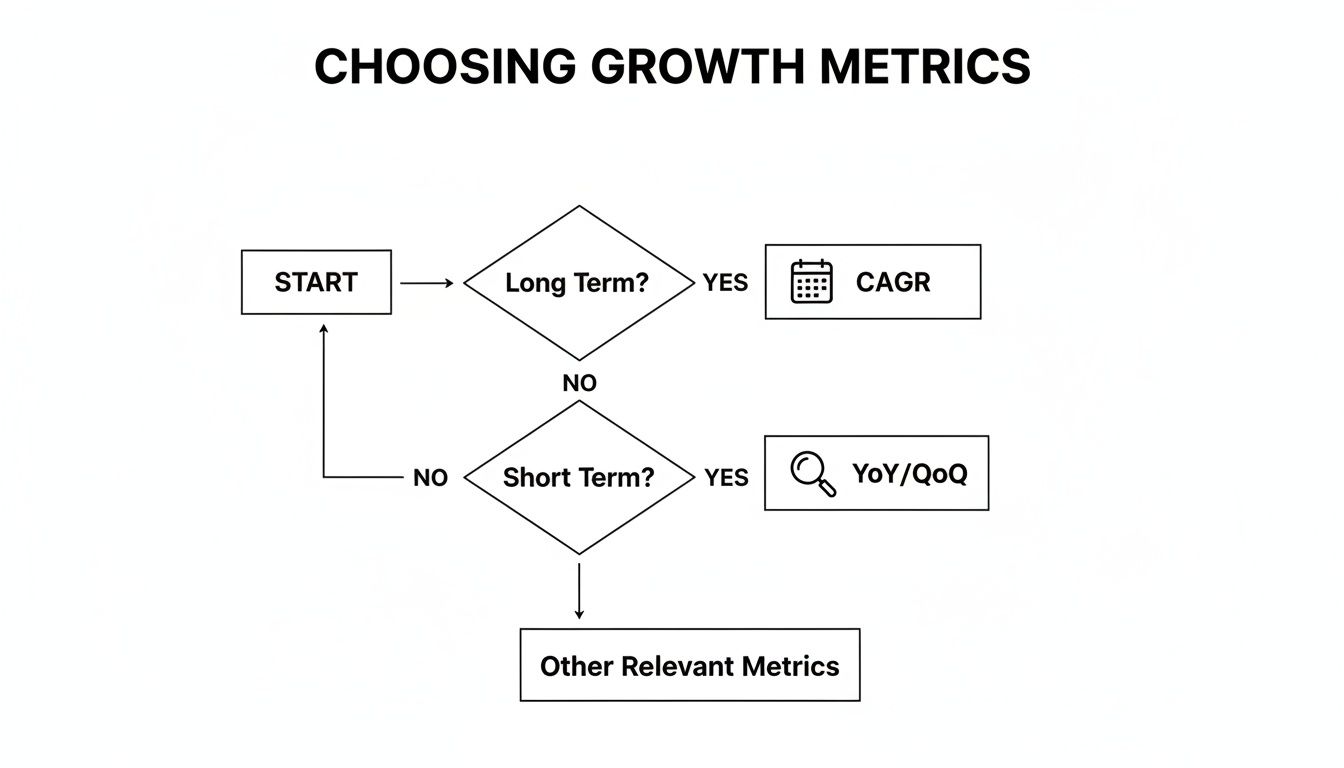
A flowchart on choosing growth metrics: CAGR for long-term, YoY/QoQ for short-term analysis.

As the visual shows, CAGR is your go-to for long-term strategic analysis, while YoY and QoQ are your tools for tactical insights over shorter timeframes.

Normalizing for Currency Fluctuations

For any business operating internationally, foreign exchange (forex) rates can create a lot of noise in the revenue figures. A 5% increase in revenue might look great on paper, but if the local currency strengthened by 7% against your reporting currency, you’ve actually lost ground in real terms.

To get a true apples-to-apples comparison, you need to calculate growth on a constant currency basis. This involves restating the previous period’s revenue using the current period’s average exchange rate. This simple adjustment strips out the impact of forex volatility and reveals your true operational growth.

Distinguishing Organic vs. Acquired Growth

Mergers and acquisitions (M&A) are another classic source of distortion. If your company buys another business, your total revenue will obviously jump. While that’s great, it’s not organic growth-it wasn’t generated by your existing operations.

To accurately gauge performance, you have to separate the two. Calculate the growth rate of your core business and analyze the acquired company’s revenue on its own before integrating it. This distinction is vital for investors, who need to understand how much growth is coming from your existing products versus how much was simply purchased. The details behind these figures are often buried in financial reports, which is why knowing how to read income statements is such a valuable skill.

Handling One-Off Events and Irregularities

Sometimes, a single, non-recurring event can dramatically inflate a period’s revenue. Think about the sale of a major asset, a large one-time legal settlement, or a bulk licensing deal that isn’t expected to happen again.

When performing a revenue growth rate calculation, always identify and exclude significant one-off events. Including them in your standard YoY or QoQ calculations will set unrealistic expectations for future periods and obscure the true health of your recurring revenue streams.

Let’s look at a quick example of how these adjustments can change the narrative. A company reports a significant jump in revenue, but a closer look reveals it’s due to currency tailwinds and a one-time asset sale.

Reported vs. Adjusted Revenue Growth Example

Metric Year 1 Revenue Year 2 Revenue Calculated Growth Rate
Reported Revenue $10,000,000 $12,500,000 25.0%
Currency Adjustment N/A -$500,000 N/A
One-Time Asset Sale N/A -$1,000,000 N/A
Adjusted Revenue $10,000,000 $11,000,000 10.0%

As you can see, the reported 25% growth rate was impressive, but the adjusted rate of 10% provides a much more realistic picture of the core business’s health.

Failing to make these adjustments can lead to poor strategic planning. You might over-invest in a sales channel based on a single fluke success or set unattainable targets for your team. The key is to footnote these events in your analysis, presenting an “adjusted” or “normalized” growth rate alongside the reported one.

Bringing Your Revenue Growth to Life with Automation and Visuals

Let’s be honest, manual calculations are a drag. They’re not just tedious; they’re a breeding ground for costly mistakes. One bad formula in a sprawling spreadsheet can throw off your entire analysis. This is exactly where modern analytics platforms like Finzer completely change the game. We can move your revenue growth rate calculation from a manual chore to an automated, insightful process.

Instead of getting bogged down in data entry, you can plug your revenue sources directly into an analytics tool. This simple connection empowers platforms like Finzer to automatically pull your data and keep your key growth metrics-YoY, QoQ, and even CAGR-updated in real-time. The payoff is huge: faster, more reliable insights you can actually trust.

Building Your Revenue Growth Dashboard

The real magic of automation happens when you visualize the data. A page full of raw numbers is hard to make sense of, but a well-designed dashboard can instantly tell a compelling story. With just a few clicks, you can transform your revenue data into dynamic charts that make trends pop off the screen.

Here are a few must-haves for any revenue growth dashboard:

  • YoY and QoQ Growth Charts: Bar or line graphs are perfect for seeing period-over-period performance at a glance.
  • CAGR Tracker: A clean numeric display or a gauge works well to highlight your smoothed, long-term growth trajectory.
  • Revenue Trend Lines: A simple line chart plotting your raw revenue over time gives crucial context to all those growth percentages.

You can immediately spot the upward trend in quarterly revenue, making it easy to share your findings with stakeholders without having to walk them through a dense spreadsheet.

From Data to Decisions

An automated dashboard does more than just save you a ton of time. It helps you make smarter, faster decisions.

When you can instantly see a dip in your QoQ growth, you can jump on it and investigate the cause right away, rather than waiting for a month-end report to tell you something went wrong. That kind of agility can be a massive competitive advantage.

By automating your revenue growth rate calculation, you shift your focus from data collection to data interpretation. You spend less time crunching numbers and more time figuring out what they mean for your business strategy.

This approach is a cornerstone of solid financial management. If you’re looking to build more robust financial reports, take a look at our guide on financial modeling best practices. At the end of the day, turning complex data into clear, actionable visuals is how you unlock the true value of your revenue metrics.

Unpacking the Nuances of Revenue Growth

Even with the right formulas, calculating revenue growth isn’t always cut and dry. Real-world business scenarios often throw a few curveballs. Let’s tackle some of the most common questions that pop up when you start digging into the numbers.

Think of this as your field guide for those tricky “what if” situations.

What’s the Difference Between Revenue Growth and Profit Growth?

It’s a classic top-line vs. bottom-line question.

Revenue growth is all about your total sales-the “top line.” It tells you how much demand there is for what you’re selling and how effectively you’re capturing the market. When this number is climbing, it’s a strong sign that your product is hitting the mark with customers.

Profit growth, on the other hand, is what’s left over after you’ve paid all your bills. It’s your “bottom line,” or net income. You can have absolutely stellar revenue growth but still see profits tumble if your costs are running wild. Both metrics are critical, but revenue growth really speaks to your market traction and potential for future scale.

How Should I Handle Negative Numbers in Growth Calculations?

This is a common sticking point. When you start with a negative number, the standard growth formula spits out a result that’s mathematically confusing and, frankly, not very useful.

Let’s say you went from a –$50k revenue month to a +$100k month. That’s a fantastic turnaround! But a percentage calculation here just muddies the waters.

When you’re dealing with negative starting revenue, ditch the percentage. It’s much clearer to focus on the absolute change in dollars. Simply stating you saw a “$150k improvement in revenue” tells a powerful and practical story of progress until you’re consistently in the black.

What Is Considered a Good Revenue Growth Rate?

There’s no single magic number here. A “good” growth rate is completely relative to your company’s stage, size, and industry.

A brand-new SaaS startup might be aiming for 100%+ year-over-year growth to satisfy its venture backers. A mature, established manufacturing company, however, would likely be ecstatic with a steady 8%.

The best way to gauge your performance is to benchmark against your direct competitors and the broader industry average. If you’re consistently outpacing the pack in your specific field, that’s always a powerful signal of a healthy, competitive business.


Ready to stop crunching numbers in spreadsheets and start seeing the bigger picture? Finzer gives you the tools to automate your calculations, visualize your growth trends, and make smarter decisions with confidence. Explore our powerful analytics platform.

<p>Calculating your revenue growth rate is simpler than you might think. At its core, the formula just measures the percentage change in your company&#8217;s revenue from one period to the next.</p> <p>You take the current period&#8217;s revenue, subtract the previous period&#8217;s revenue, and then divide that number by the previous period&#8217;s revenue. Multiply by <strong>100</strong>, and you&#8217;ve got your percentage. This is one of the most fundamental metrics for understanding a business&#8217;s health and momentum.</p> <h3>What Revenue Growth Rate Reveals About Your Business</h3> <p>This isn&#8217;t just a number to stick in a spreadsheet; think of the revenue growth rate as the pulse of your company. It’s a vital sign that investors, founders, and marketing teams all watch closely because it’s a direct reflection of your market traction and competitive strength. Forget the dry definitions-this metric is the language of business momentum.</p> <p>A strong, consistent growth rate tells a powerful story. It signals that your products are hitting the mark, your sales and marketing engines are firing on all cylinders, and you&#8217;re successfully carving out your piece of the market. For founders, it&#8217;s the ultimate validation of their vision.</p> <h3>Informing Key Business Decisions</h3> <p>A positive trend in your revenue growth can be the green light for major strategic moves. It gives you the confidence and, more importantly, the hard data to chase new opportunities or reallocate resources where they&#8217;ll have the most impact. This metric is also a massive factor in determining a company&#8217;s worth.</p> <p>Revenue growth directly influences several critical decisions:</p> <ul> <li><strong>Securing Funding:</strong> Investors live and breathe growth rates. A healthy percentage is often the single most compelling slide in a pitch deck because it points to future potential.</li> <li><strong>Budget Allocation:</strong> When growth is trending up, it’s much easier to justify a bigger marketing spend, new hires, or that product development project you&#8217;ve been wanting to start.</li> <li><strong>Strategic Planning:</strong> The numbers help leadership decide whether it’s time to go for aggressive expansion, dig deeper into the current market, or just consolidate recent gains.</li> </ul> <blockquote><p>Understanding your growth is the first step to improving it. This metric is your go-to for evaluating performance, justifying your valuation, and spotting trouble before it gets out of hand.</p></blockquote> <h3>Introducing the Core Calculation Methods</h3> <p>To get a clear picture, you need the right tool for the job. There are a few standard ways to calculate revenue growth, each offering a different lens on your company’s performance. The most common is the simple year-over-year formula: <strong>(Current Year Revenue − Previous Year Revenue) / Previous Year Revenue × 100</strong>. It&#8217;s the same fundamental approach used to track massive economic shifts, like the swings in global GDP during the 2020 pandemic.</p> <p>Here are the primary metrics we’ll be breaking down:</p> <ul> <li><strong>Year-over-Year (YoY) Growth:</strong> This is the workhorse for comparing performance across twelve-month periods, smoothing out any seasonal bumps.</li> <li><strong>Quarter-over-Quarter (QoQ) Growth:</strong> Perfect for getting a read on short-term momentum and spotting trends as they emerge.</li> <li><strong>Compound Annual Growth Rate (CAGR):</strong> This gives you a smoothed-out average growth rate over several years, offering a much clearer view of your long-term trajectory.</li> </ul> <h3>Key Revenue Growth Formulas at a Glance</h3> <p>To make things easy, here’s a quick-reference table summarizing the main formulas you&#8217;ll be using. Each one provides a different perspective, so knowing when to use which is half the battle.</p> <table> <thead> <tr> <th align="left">Metric (Abbreviation)</th> <th align="left">Formula</th> <th align="left">Best Used For</th> </tr> </thead> <tbody> <tr> <td align="left"><strong>Year-over-Year (YoY)</strong></td> <td align="left">(Current Period Revenue − Prior Year&#8217;s Period Revenue) / Prior Year&#8217;s Period Revenue</td> <td align="left">Annual performance reviews, smoothing seasonality, long-term trend analysis.</td> </tr> <tr> <td align="left"><strong>Quarter-over-Quarter (QoQ)</strong></td> <td align="left">(Current Quarter Revenue − Previous Quarter Revenue) / Previous Quarter Revenue</td> <td align="left">Tracking short-term momentum, assessing the impact of recent initiatives, identifying seasonal patterns.</td> </tr> <tr> <td align="left"><strong>Compound Annual Growth Rate (CAGR)</strong></td> <td align="left">[(Ending Value / Beginning Value)^(1 / Number of Years)] &#8211; 1</td> <td align="left">Measuring the average annual growth over multiple years, especially for volatile businesses or long-term investments.</td> </tr> </tbody> </table> <p>Think of these as different lenses. YoY gives you the big picture, QoQ provides the close-up, and CAGR shows you the smoothed-out historical film of your company&#8217;s journey.</p> <h2>How to Calculate Core Revenue Growth Metrics</h2> <p>Alright, let&#8217;s roll up our sleeves and get practical. Knowing the theory is one thing, but calculating these numbers is where the real insights come from. We&#8217;re going to walk through the three most essential formulas you&#8217;ll be using constantly.</p> <p>Each of these metrics-Year-over-Year (YoY), Quarter-over-Quarter (QoQ), and the Compound Annual Growth Rate (CAGR)-tells a unique story about your company’s performance. Mastering them is non-negotiable for making sense of the data.</p> <h3>Calculating Year-over-Year (YoY) Growth</h3> <p>When you want to gauge your annual performance, <strong>Year-over-Year (YoY) growth</strong> is your go-to metric. It&#8217;s the classic way to compare a specific period (like a quarter or the full year) against the same exact period from the year before.</p> <p>This method is so powerful because it naturally smooths out any seasonal weirdness in your numbers. Think retail&#8217;s Q4 holiday rush-comparing it to Q3 would be misleading, but comparing it to the <em>previous</em> Q4 gives you a true sense of your underlying growth.</p> <p>The formula itself is pretty straightforward:<br /> <strong>YoY Growth = [(Current Period Revenue − Prior Year&#8217;s Period Revenue) / Prior Year&#8217;s Period Revenue] × 100</strong></p> <p>Let’s put this into practice with a fictional e-commerce company, &#8220;GlowGadgets.&#8221;</p> <ul> <li><strong>2022 Revenue:</strong> <strong>$500,000</strong></li> <li><strong>2023 Revenue:</strong> <strong>$650,000</strong></li> </ul> <p>Plugging those numbers into the formula:<br /> YoY Growth = [($650,000 &#8211; $500,000) / $500,000] × 100 = <strong>30%</strong></p> <p>That <strong>30%</strong> YoY growth is a fantastic result for GlowGadgets. It&#8217;s a clear, strong signal of health that investors and stakeholders love to see.</p> <h3>Measuring Quarter-over-Quarter (QoQ) Momentum</h3> <p>While YoY is perfect for the big picture, sometimes you need a more immediate pulse check on your business. That&#8217;s where <strong>Quarter-over-Quarter (QoQ) growth</strong> comes in. It compares your revenue from one quarter to the one that just ended.</p> <p>This calculation is incredibly useful for seeing the short-term impact of your recent decisions. Did that new marketing campaign work? Did the latest product launch hit the mark? QoQ will give you a quick answer.</p> <p>The formula looks familiar, just with a shorter timeframe:<br /> <strong>QoQ Growth = [(Current Quarter Revenue − Previous Quarter Revenue) / Previous Quarter Revenue] × 100</strong></p> <blockquote><p>A sudden dip in QoQ growth can be an early warning sign that something isn&#8217;t right, giving you a chance to pivot quickly. On the flip side, a big spike can instantly validate a new strategy.</p></blockquote> <p>Let&#8217;s check back in with GlowGadgets:</p> <ul> <li><strong>Q2 2023 Revenue:</strong> <strong>$150,000</strong></li> <li><strong>Q3 2023 Revenue:</strong> <strong>$180,000</strong></li> </ul> <p>Applying the formula:<br /> QoQ Growth = [($180,000 &#8211; $150,000) / $150,000] × 100 = <strong>20%</strong></p> <p>A <strong>20%</strong> bump from Q2 is a great sign of momentum for GlowGadgets. This kind of short-term view is what you need for agile operational planning. To really dig in and understand what&#8217;s driving these numbers, you need solid revenue analytics that actually drive growth.</p> <h3>Understanding the Compound Annual Growth Rate (CAGR)</h3> <p>Last but certainly not least is the <strong>Compound Annual Growth Rate (CAGR)</strong>. This one is the gold standard for measuring long-term performance. Why? Because it gives you a smoothed-out average growth rate over several years, accounting for the powerful effect of compounding.</p> <p>CAGR answers a critical question: &#8220;If our revenue grew at a steady, consistent pace each year, what would that rate have to be to get from our starting point to our ending point?&#8221;</p> <p>The formula is a bit more involved, but it&#8217;s worth it:<br /> <strong>CAGR = {[(Ending Value / Beginning Value)^(1 / Number of Years)] &#8211; 1} × 100</strong></p> <p>Let&#8217;s look at GlowGadgets&#8217; journey over a couple of years:</p> <ul> <li><strong>2021 (Beginning Value):</strong> <strong>$400,000</strong></li> <li><strong>2023 (Ending Value):</strong> <strong>$650,000</strong></li> <li><strong>Number of Years:</strong> <strong>2</strong> (from the end of 2021 to the end of 2023)</li> </ul> <p>Let&#8217;s crunch those numbers:<br /> CAGR = {[(650,000 / 400,000)^(1 / 2)] &#8211; 1} × 100 = <strong>27.5%</strong></p> <p>GlowGadgets&#8217; CAGR of <strong>27.5%</strong> over two years paints a picture of strong, sustained growth. This is the figure that demonstrates a stable trajectory, ironing out any single year&#8217;s bumps or booms, and it’s a number that long-term investors pay very close attention to.</p> <h2>Using CAGR for a Clearer Long-Term Picture</h2> <p>While Year-over-Year growth gives you a snapshot and Quarter-over-Quarter tracks short-term sprints, the <strong>Compound Annual Growth Rate (CAGR)</strong> provides the panoramic, long-term view. It’s the metric that irons out the bumps and dips of single periods, giving you a much more honest picture of your company&#8217;s underlying growth trajectory over time.</p> <p>CAGR essentially answers one critical question: &#8220;If our company grew at a steady, consistent rate every single year, what would that rate have been to get from our starting revenue to our ending revenue?&#8221; It’s a hypothetical number, but it&#8217;s incredibly powerful for comparing your performance over multiple years or sizing yourself up against competitors.</p> <p>The formula looks a bit more intimidating, but it&#8217;s a must-know for any serious revenue analysis:</p> <p><strong>CAGR = [(Ending Value / Beginning Value)^(1 / Number of Periods)] &#8211; 1</strong></p> <h3>Putting CAGR into Practice</h3> <p>Let&#8217;s walk through a real-world scenario. Picture a tech startup, &#8220;Innovate Solutions,&#8221; and look at their revenue over the last five years:</p> <ul> <li><strong>Year 1:</strong> <strong>$2.0 Million</strong></li> <li><strong>Year 2:</strong> <strong>$2.5 Million</strong> (25% YoY growth)</li> <li><strong>Year 3:</strong> <strong>$3.0 Million</strong> (20% YoY growth)</li> <li><strong>Year 4:</strong> <strong>$3.3 Million</strong> (10% YoY growth &#8211; a slow year)</li> <li><strong>Year 5:</strong> <strong>$4.5 Million</strong> (36.4% YoY growth &#8211; a huge comeback)</li> </ul> <p>As you can see, the annual growth rates are all over the place. A simple average would be totally misleading. This is where CAGR steps in to find the smooth, consistent growth rate over the entire four-year period.</p> <ul> <li><strong>Beginning Value:</strong> <strong>$2.0 Million</strong> (from Year 1)</li> <li><strong>Ending Value:</strong> <strong>$4.5 Million</strong> (from Year 5)</li> <li><strong>Number of Periods (Years):</strong> <strong>4</strong> (the number of growth intervals between Year 1 and Year 5)</li> </ul> <p>Plugging these into the formula:</p> <p>CAGR = [($4.5M / $2.0M)^(1/4)] &#8211; 1 = <strong>22.5%</strong></p> <p>That <strong>22.5%</strong> CAGR tells a much clearer story about Innovate Solutions&#8217; journey than the volatile yearly numbers. It points to a strong, sustained growth engine humming beneath the surface. If you want to get even deeper into this metric, check out our detailed guide on <strong><a href="https://finzer.io/en/blog/what-is-compound-annual-growth-rate">what the Compound Annual Growth Rate is</a></strong> and how to apply it.</p> <h3>Benchmarking Your CAGR Against Industry Standards</h3> <p>Calculating your CAGR is only half the battle. The other half is context. A <strong>22.5%</strong> CAGR might be phenomenal for a stable manufacturing business, but it could be just average for a venture-backed software startup. This is where you absolutely have to look at industry benchmarks.</p> <blockquote><p>CAGR is the go-to metric for expressing multi-period growth because it smooths out volatility. But historical data shows massive differences between sectors, making industry-specific comparisons essential for a true assessment of performance.</p></blockquote> <p>For instance, long-run compounded annual growth rates for the total market have hovered around <strong>9.1%</strong>. Digging deeper, specific sectors vary wildly. Semiconductors have shown a historical CAGR of about <strong>19.4%</strong>, while many retail and utility subsectors post much lower single-digit rates.</p> <p>You can explore more of these fantastic data sets on <a href="https://pages.stern.nyu.edu/~adamodar/New_Home_Page/datafile/histgr.html">NYU Stern&#8217;s historical growth rates page</a>. Having this context is crucial-it&#8217;s how you know if your growth is just good, or truly great.</p> <h2>Adjusting Your Calculations for Real-World Business Events</h2> <p>Calculating revenue growth seems straightforward on the surface, but in the real world, the numbers are rarely clean. A raw calculation can be easily skewed by major business events, giving you a distorted picture of a company&#8217;s actual performance.</p> <p>Learning how to adjust for these events is crucial for seeing the true story behind the numbers. Without these adjustments, you might mistake a temporary spike for sustainable growth or miss an underlying problem masked by a one-off gain. The goal is always to isolate the performance of the core business to make smarter, more informed decisions.</p> <p>This flowchart can help you decide which growth metric is best suited for your analysis.</p> <figure class="wp-block-image size-large"><img data-recalc-dims="1" decoding="async" src="https://i0.wp.com/cdn.outrank.so/6540ba8a-af29-418a-9ef5-c1e2a673f1e1/20db3fbc-f72d-417c-b1a9-87e748b32694/revenue-growth-rate-calculation-growth-metrics.jpg?ssl=1" alt="A flowchart on choosing growth metrics: CAGR for long-term, YoY/QoQ for short-term analysis." /></figure> <p>As the visual shows, CAGR is your go-to for long-term strategic analysis, while YoY and QoQ are your tools for tactical insights over shorter timeframes.</p> <h3>Normalizing for Currency Fluctuations</h3> <p>For any business operating internationally, foreign exchange (forex) rates can create a lot of noise in the revenue figures. A <strong>5%</strong> increase in revenue might look great on paper, but if the local currency strengthened by <strong>7%</strong> against your reporting currency, you&#8217;ve actually lost ground in real terms.</p> <p>To get a true apples-to-apples comparison, you need to calculate growth on a <strong>constant currency basis</strong>. This involves restating the previous period&#8217;s revenue using the current period&#8217;s average exchange rate. This simple adjustment strips out the impact of forex volatility and reveals your true operational growth.</p> <h3>Distinguishing Organic vs. Acquired Growth</h3> <p>Mergers and acquisitions (M&amp;A) are another classic source of distortion. If your company buys another business, your total revenue will obviously jump. While that&#8217;s great, it’s not <strong>organic growth</strong>-it wasn&#8217;t generated by your existing operations.</p> <p>To accurately gauge performance, you have to separate the two. Calculate the growth rate of your core business and analyze the acquired company&#8217;s revenue on its own before integrating it. This distinction is vital for investors, who need to understand how much growth is coming from your existing products versus how much was simply purchased. The details behind these figures are often buried in financial reports, which is why knowing <strong><a href="https://finzer.io/en/blog/how-to-read-income-statements">how to read income statements</a></strong> is such a valuable skill.</p> <h3>Handling One-Off Events and Irregularities</h3> <p>Sometimes, a single, non-recurring event can dramatically inflate a period&#8217;s revenue. Think about the sale of a major asset, a large one-time legal settlement, or a bulk licensing deal that isn&#8217;t expected to happen again.</p> <blockquote><p>When performing a revenue growth rate calculation, always identify and exclude significant one-off events. Including them in your standard YoY or QoQ calculations will set unrealistic expectations for future periods and obscure the true health of your recurring revenue streams.</p></blockquote> <p>Let&#8217;s look at a quick example of how these adjustments can change the narrative. A company reports a significant jump in revenue, but a closer look reveals it&#8217;s due to currency tailwinds and a one-time asset sale.</p> <p><strong>Reported vs. Adjusted Revenue Growth Example</strong></p> <table> <thead> <tr> <th align="left">Metric</th> <th align="left">Year 1 Revenue</th> <th align="left">Year 2 Revenue</th> <th align="left">Calculated Growth Rate</th> </tr> </thead> <tbody> <tr> <td align="left"><strong>Reported Revenue</strong></td> <td align="left">$10,000,000</td> <td align="left">$12,500,000</td> <td align="left"><strong>25.0%</strong></td> </tr> <tr> <td align="left"><strong>Currency Adjustment</strong></td> <td align="left">N/A</td> <td align="left">-$500,000</td> <td align="left">N/A</td> </tr> <tr> <td align="left"><strong>One-Time Asset Sale</strong></td> <td align="left">N/A</td> <td align="left">-$1,000,000</td> <td align="left">N/A</td> </tr> <tr> <td align="left"><strong>Adjusted Revenue</strong></td> <td align="left">$10,000,000</td> <td align="left">$11,000,000</td> <td align="left"><strong>10.0%</strong></td> </tr> </tbody> </table> <p>As you can see, the reported <strong>25%</strong> growth rate was impressive, but the adjusted rate of <strong>10%</strong> provides a much more realistic picture of the core business&#8217;s health.</p> <p>Failing to make these adjustments can lead to poor strategic planning. You might over-invest in a sales channel based on a single fluke success or set unattainable targets for your team. The key is to footnote these events in your analysis, presenting an &#8220;adjusted&#8221; or &#8220;normalized&#8221; growth rate alongside the reported one.</p> <h2>Bringing Your Revenue Growth to Life with Automation and Visuals</h2> <p>Let&#8217;s be honest, manual calculations are a drag. They&#8217;re not just tedious; they&#8217;re a breeding ground for costly mistakes. One bad formula in a sprawling spreadsheet can throw off your entire analysis. This is exactly where modern analytics platforms like Finzer completely change the game. We can move your <strong>revenue growth rate calculation</strong> from a manual chore to an automated, insightful process.</p> <p>Instead of getting bogged down in data entry, you can plug your revenue sources directly into an analytics tool. This simple connection empowers platforms like Finzer to automatically pull your data and keep your key growth metrics-YoY, QoQ, and even CAGR-updated in real-time. The payoff is huge: faster, more reliable insights you can actually trust.</p> <h3>Building Your Revenue Growth Dashboard</h3> <p>The real magic of automation happens when you visualize the data. A page full of raw numbers is hard to make sense of, but a well-designed dashboard can instantly tell a compelling story. With just a few clicks, you can transform your revenue data into dynamic charts that make trends pop off the screen.</p> <p>Here are a few must-haves for any revenue growth dashboard:</p> <ul> <li><strong>YoY and QoQ Growth Charts:</strong> Bar or line graphs are perfect for seeing period-over-period performance at a glance.</li> <li><strong>CAGR Tracker:</strong> A clean numeric display or a gauge works well to highlight your smoothed, long-term growth trajectory.</li> <li><strong>Revenue Trend Lines:</strong> A simple line chart plotting your raw revenue over time gives crucial context to all those growth percentages.</li> </ul> <p>You can immediately spot the upward trend in quarterly revenue, making it easy to share your findings with stakeholders without having to walk them through a dense spreadsheet.</p> <h3>From Data to Decisions</h3> <p>An automated dashboard does more than just save you a ton of time. It helps you make smarter, faster decisions.</p> <p>When you can instantly see a dip in your QoQ growth, you can jump on it and investigate the cause right away, rather than waiting for a month-end report to tell you something went wrong. That kind of agility can be a massive competitive advantage.</p> <blockquote><p>By automating your revenue growth rate calculation, you shift your focus from <em>data collection</em> to <em>data interpretation</em>. You spend less time crunching numbers and more time figuring out what they mean for your business strategy.</p></blockquote> <p>This approach is a cornerstone of solid financial management. If you&#8217;re looking to build more robust financial reports, take a look at our guide on <strong><a href="https://finzer.io/en/blog/financial-modeling-best-practices">financial modeling best practices</a></strong>. At the end of the day, turning complex data into clear, actionable visuals is how you unlock the true value of your revenue metrics.</p> <h2>Unpacking the Nuances of Revenue Growth</h2> <p>Even with the right formulas, calculating revenue growth isn&#8217;t always cut and dry. Real-world business scenarios often throw a few curveballs. Let&#8217;s tackle some of the most common questions that pop up when you start digging into the numbers.</p> <p>Think of this as your field guide for those tricky &#8220;what if&#8221; situations.</p> <h3>What’s the Difference Between Revenue Growth and Profit Growth?</h3> <p>It’s a classic top-line vs. bottom-line question.</p> <p>Revenue growth is all about your total sales-the &#8220;top line.&#8221; It tells you how much demand there is for what you&#8217;re selling and how effectively you&#8217;re capturing the market. When this number is climbing, it&#8217;s a strong sign that your product is hitting the mark with customers.</p> <p>Profit growth, on the other hand, is what’s left over after you’ve paid all your bills. It&#8217;s your &#8220;bottom line,&#8221; or net income. You can have absolutely stellar revenue growth but still see profits tumble if your costs are running wild. Both metrics are critical, but revenue growth really speaks to your market traction and potential for future scale.</p> <h3>How Should I Handle Negative Numbers in Growth Calculations?</h3> <p>This is a common sticking point. When you start with a negative number, the standard growth formula spits out a result that’s mathematically confusing and, frankly, not very useful.</p> <p>Let’s say you went from a <strong>–$50k</strong> revenue month to a <strong>+$100k</strong> month. That’s a fantastic turnaround! But a percentage calculation here just muddies the waters.</p> <blockquote><p>When you&#8217;re dealing with negative starting revenue, ditch the percentage. It’s much clearer to focus on the absolute change in dollars. Simply stating you saw a &#8220;<strong>$150k improvement in revenue</strong>&#8221; tells a powerful and practical story of progress until you&#8217;re consistently in the black.</p></blockquote> <h3>What Is Considered a Good Revenue Growth Rate?</h3> <p>There&#8217;s no single magic number here. A &#8220;good&#8221; growth rate is completely relative to your company&#8217;s stage, size, and industry.</p> <p>A brand-new SaaS startup might be aiming for <strong>100%+</strong> year-over-year growth to satisfy its venture backers. A mature, established manufacturing company, however, would likely be ecstatic with a steady <strong>8%</strong>.</p> <p>The best way to gauge your performance is to benchmark against your direct competitors and the broader industry average. If you&#8217;re consistently outpacing the pack in your specific field, that&#8217;s always a powerful signal of a healthy, competitive business.</p> <hr /> <p>Ready to stop crunching numbers in spreadsheets and start seeing the bigger picture? <strong>Finzer</strong> gives you the tools to automate your calculations, visualize your growth trends, and make smarter decisions with confidence. <a href="https://finzer.io">Explore our powerful analytics platform</a>.</p>

Maximize Your Investment Insights with Finzer

Explore powerful screening tools and discover smarter ways to analyze stocks.